Amphibians
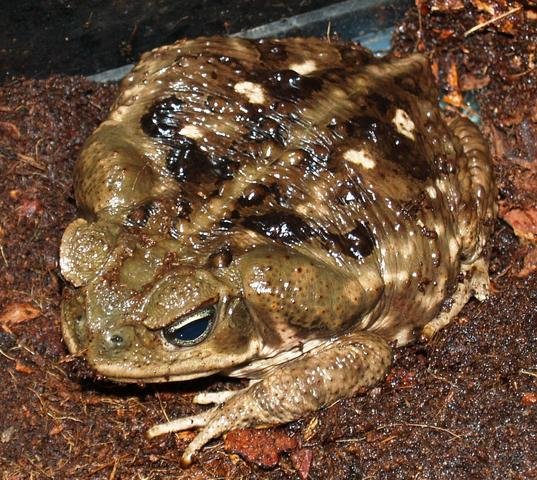
Cane Toad (Rhinella marina)
https://www2.hawaii.edu/~yamaga/canetoads.html
There are more than 8,000 species of amphibians in the world (AmphibiaWeb), and over 400 species occur in the Amazon rainforest (Amazon Conservation Association). Amphibians include frogs, toads, salamanders, and caecilians, although frogs and toads account for the overwhelming majority of Amazonian species.
Most amphibians are carnivores that feed on insects and other small invertebrates, helping regulate arthropod populations. Tadpoles of many species feed on algae and decaying organic matter, making them important components of freshwater ecosystems. Amphibians are also prey for fish, birds, reptiles, and mammals, making them an important link in food webs.
Amphibians are among the most threatened groups of vertebrates. Habitat destruction, pollution, climate change, and infectious diseases have caused severe population declines worldwide. One of the greatest threats is chytridiomycosis, a disease caused by chytrid fungi that has contributed to the decline or extinction of hundreds of species. The loss of amphibians represents not only the disappearance of unique forms of life, but also the disruption of ecosystems that depend on them.
Several Amazonian amphibians are particularly noteworthy.
Cane Toad
The cane toad (Rhinella marina) is the largest amphibian native to the Amazon rainforest and can grow up to 9 inches (23 cm) long (Florida Fish and Wildlife Conservation Commission). Although introduced populations in places such as Australia and Florida have become invasive pests, the species is a natural and important part of Amazonian ecosystems. Its toxic skin secretions help protect it from predators.
Suriname Toad
The Suriname toad (Pipa pipa) is one of the strangest amphibians in the world. Its body is remarkably flat, allowing it to blend in with leaf litter on the bottoms of ponds and streams. After mating, the male places the eggs on the female's back, where they become embedded in her skin. A membrane grows over the eggs, and the developing young remain there until fully formed toadlets emerge from her back (San Diego Zoo Wildlife Alliance).
Glass Frogs
Glass frogs (family Centrolenidae) are small tree frogs famous for their transparent skin. Many species have translucent undersides through which their organs can be seen. There are approximately 160 species of glass frogs, and many are threatened with extinction. Most species are only about an inch long and spend much of their lives in vegetation near streams, where males guard eggs laid on leaves above the water (International Fund for Animal Welfare; Britannica).
References:
Amphibian species by the numbers Amphibiaweb
https://amphibiaweb.org/amphibian/speciesnums.html
Birds and Wildlife Amazon Conservation Association
Cane Toad Florida Fish and Wildlife Conservation Commission
Suriname Toad San Deigo Zoo Wildlife Alliance
Glass Frogs International Fund for Animal Welfare
https://www.ifaw.org/animals/glass-frogs
Zug, George R, Glass Frog Britannica
https://www.britannica.com/animal/amphibian