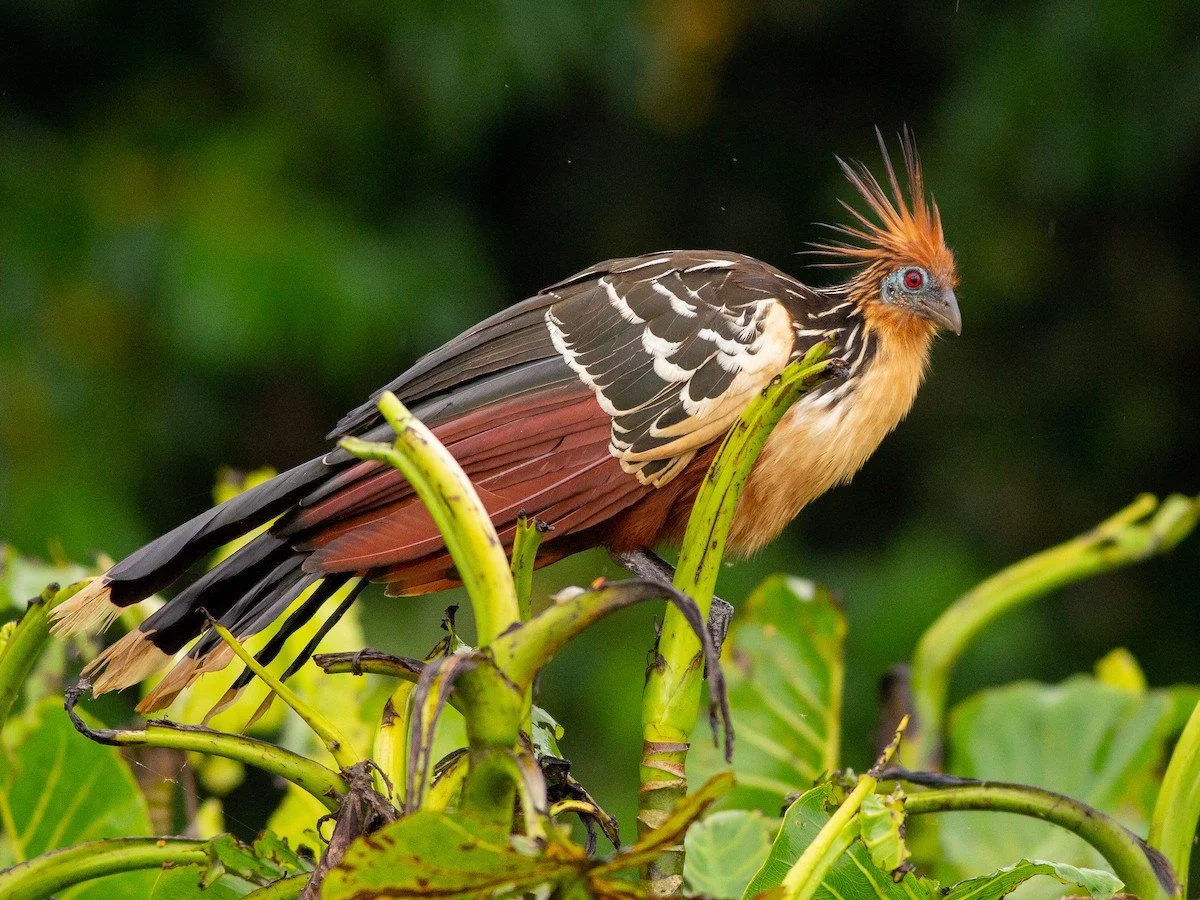
Hoatzin
Hoatzin ebird
The Hoatzin (Opisthocomus hoazin) is perhaps the most unusual bird found in the Amazon rainforest. Native to the swamps, floodplains, and river-edge forests of the Amazon and Orinoco basins, the Hoatzin is so distinctive that it occupies its own family and order. Its unusual appearance, unique digestive system, and primitive characteristics have fascinated scientists for generations. Because of its distinctive odor, the species is often referred to as the "stinkbird" by local residents.
Unlike most birds, which feed on fruits, seeds, insects, or small animals, the Hoatzin feeds primarily on leaves, shoots, and other vegetation. Leaves are abundant throughout the rainforest but are difficult to digest because they contain large amounts of cellulose and relatively few nutrients. To overcome this challenge, the Hoatzin has evolved a remarkable digestive system unlike that of any other bird. Its enlarged crop functions as a fermentation chamber where symbiotic bacteria break down plant material before it reaches the stomach. This process is similar to the foregut fermentation used by cattle, deer, and other ruminant mammals. The fermentation process produces gases and contributes to the bird's distinctive manure-like odor (San Francisco Zoo).
This unusual feeding strategy allows Hoatzins to exploit a food source that relatively few other birds can utilize efficiently. While many Amazonian animals compete for fruits, seeds, and insects, the Hoatzin occupies a niche with comparatively little competition. By specializing in leaves, it is able to take advantage of one of the rainforest's most abundant resources. This specialization helps explain why Hoatzins are commonly found in areas with dense riverside vegetation where suitable foliage is readily available.
The Hoatzin's digestive system has influenced other aspects of its biology as well. The enlarged crop occupies much of the bird's chest cavity, reducing the space available for the powerful flight muscles found in most birds. As a result, Hoatzins are relatively weak fliers. Rather than undertaking long flights, they typically move through the vegetation by climbing, hopping, or making short, labored flights between trees. This behavior reflects their adaptation to the dense, wet habitats where they spend most of their lives.
One of the most remarkable features of the Hoatzin is found in its young. Hoatzin chicks possess claws on the first two digits of each wing, a characteristic rarely seen in modern birds. These claws serve an important purpose. When threatened by predators such as snakes, monkeys, or birds of prey, chicks may drop from their nests into the water below. After escaping danger, they can swim to shore and use their wing claws to climb through vegetation back to the nest. As the birds mature, the claws become greatly reduced and lose most of their function. This trait has often been compared to the wing claws of ancient birds such as Archaeopteryx, giving the Hoatzin an almost prehistoric appearance.
Scientists have long been intrigued by the Hoatzin because it differs so dramatically from other living birds. For decades, researchers debated where it belongs on the avian family tree. Its unique combination of characteristics—including its digestive system, skeletal anatomy, behavior, and wing-clawed chicks—has made it one of the most challenging birds to classify. Modern genetic studies indicate that it represents a highly distinct evolutionary lineage, but its exact relationships to other bird groups remain a topic of scientific interest.
Beyond its biological peculiarities, the Hoatzin plays an important ecological role in Amazonian wetlands. By feeding on leaves and vegetation, it helps transfer energy from plants into the broader food web. It also disperses seeds from some of the plants it consumes and serves as prey for a variety of predators. Although it is not a top predator or a keystone species like the jaguar or Harpy Eagle, the Hoatzin contributes to the complexity and biodiversity of Amazonian ecosystems.
The International Union for Conservation of Nature (IUCN) currently classifies the Hoatzin as a species of Least Concern. Nevertheless, it depends on healthy wetland habitats, river margins, and flooded forests. Deforestation, drainage of wetlands, and degradation of riparian habitats could negatively affect local populations. Protecting Amazonian waterways and floodplain forests helps preserve not only the Hoatzin but also countless other species that depend on these unique environments.
The Hoatzin serves as a reminder that evolution does not always produce familiar solutions to ecological challenges. While many birds evolved to hunt insects, gather seeds, or consume fruit, the Hoatzin took a very different path, becoming a leaf-eating specialist with a digestive system more reminiscent of a cow than a bird. Its combination of unusual anatomy, primitive features, and ecological specialization makes it one of the most fascinating animals in the Amazon rainforest
References:
Hoatzin San Francisco Zoo