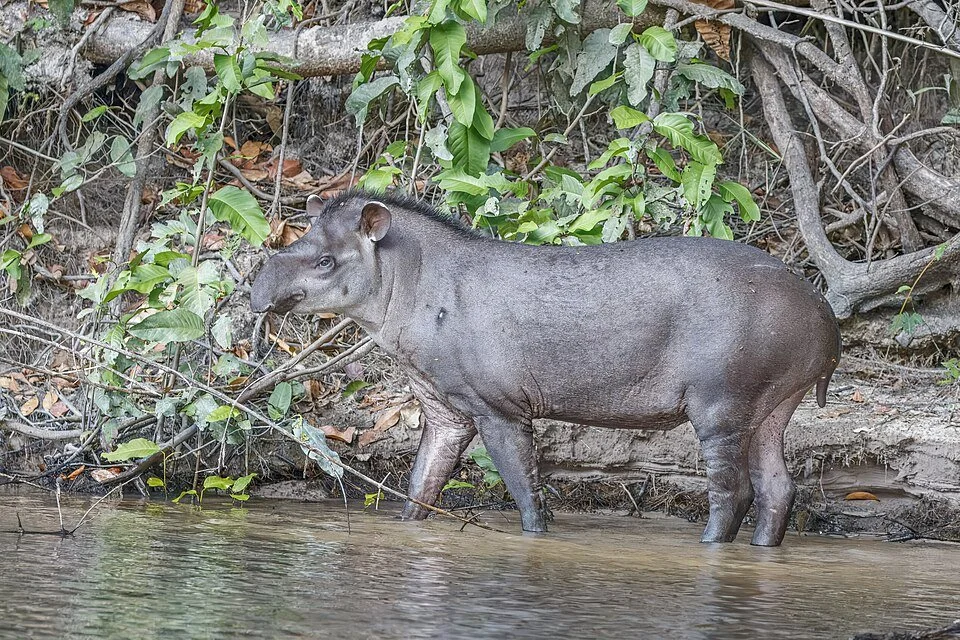
Tapir
There are two species of tapir found in the Amazon region: the Brazilian tapir (Tapirus terrestris), also known as the lowland tapir, which inhabits the Amazon Basin itself, and the Andean tapir (Tapirus pinchaque), also known as the mountain tapir, which inhabits the cloud forests of the Andes Mountains bordering the Amazon. Tapirs are the largest native land mammals in much of the Amazon region and are among the most important large herbivores in Neotropical ecosystems.
Despite somewhat resembling pigs, tapirs are actually more closely related to horses and rhinoceroses. One of their most distinctive features is their flexible, trunk-like snout, which they use to grasp leaves, fruits, and other vegetation. Tapirs are primarily browsers rather than grazers, feeding on leaves, aquatic plants, shoots, bark, and large quantities of fruit. The Brazilian tapir in particular consumes many fallen fruits and is capable of dispersing large seeds across long distances through its droppings.
Due to their role in spreading seeds, Brazilian tapirs are considered an important keystone species within the Amazon rainforest. Some plant species rely heavily on large animals like tapirs to disperse their seeds. Research has shown that tapirs can help restore damaged forests by transporting seeds into deforested or degraded areas. In some cases, tapirs may play a direct role in rainforest regeneration by helping new plants establish themselves in recovering habitats (Bittel, 2019).
The Brazilian tapir is currently listed as Vulnerable by the International Union for Conservation of Nature (IUCN). Major threats include habitat destruction, road construction, hunting, and fragmentation of the rainforest. Due to the fact that tapirs reproduce slowly, with females usually giving birth to only one calf after a long gestation period, populations can take a long time to recover from declines.
The Andean tapir faces even greater threats and is currently listed as Endangered by the IUCN. It is the smallest and woolliest tapir species, adaptations that help it survive in the cool temperatures of high-elevation cloud forests and páramo ecosystems. Habitat loss from agriculture, cattle grazing, mining, and human settlement has severely reduced and fragmented Andean tapir populations. Climate change may further threaten the species by altering the fragile mountain ecosystems it depends upon.
Tapirs are also strongly associated with water and are excellent swimmers. Brazilian tapirs frequently enter rivers and wetlands to cool off, avoid insects, and escape predators such as jaguars. Their semi-aquatic habits allow them to move through flooded forests and river systems that are difficult for many other large mammals to navigate.
Although tapirs are generally shy and solitary animals, they play an outsized ecological role within the Amazon region. The loss of large seed dispersers such as tapirs could significantly alter forest composition over time, demonstrating how the survival of a single herbivore species can influence the health of an entire rainforest ecosystem.
References:
Lowland Tapir IUCN Red List
https://www.iucnredlist.org/species/21474/45174127
Mountain Tapir IUCN Red List
https://www.iucnredlist.org/species/21473/45173922
Bittel, Jason. (May 2, 2019) How to Regrow a Rainforest? Send in the Tapirs. NRDC
https://www.nrdc.org/stories/how-do-you-regrow-rainforest-send-tapirs