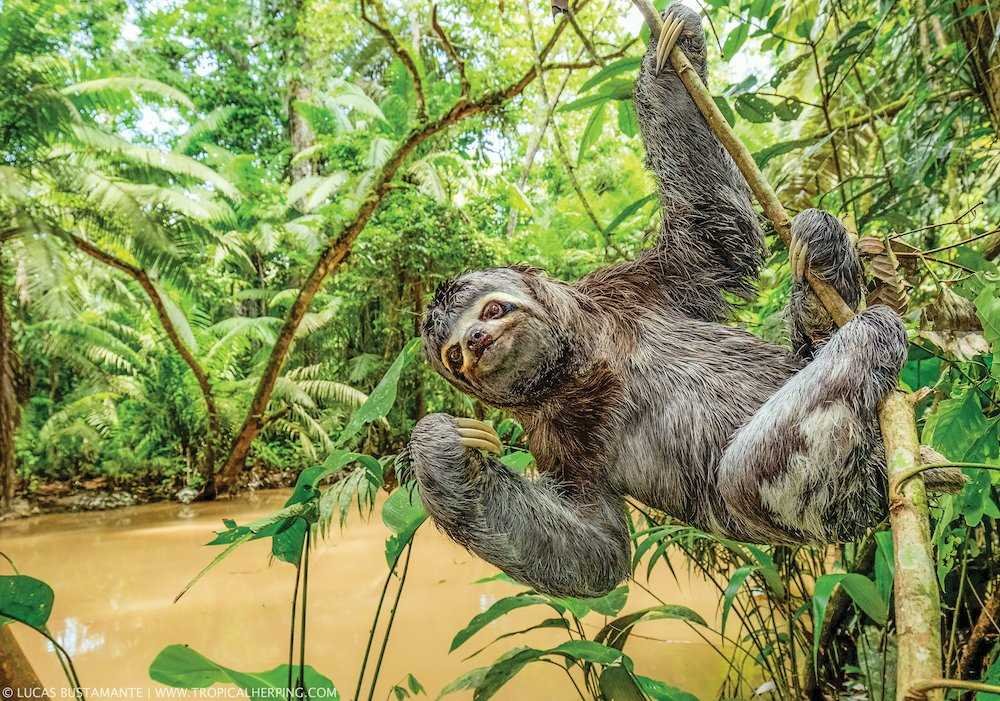
Three Toed Sloths
Brown Throated Three Toed Sloth National Geographic
https://www.expeditions.com/expedition-stories/stories/wild-personalities-brown-throated-sloth
Three-toed sloths (Bradypus spp.) are among the most unusual and specialized mammals of the Amazon rainforest. Of the four living species of three-toed sloths, two inhabit the Amazon region: the brown-throated three-toed sloth (Bradypus variegatus), which occupies much of the Amazon Basin except the far northern region, and the pale-throated sloth (Bradypus tridactylus), which primarily inhabits the northern Amazon (Moraes-Barros, 2011). These arboreal mammals spend nearly their entire lives suspended upside down in the rainforest canopy.
Three-toed sloths are highly specialized herbivores that feed primarily on leaves. Leaves are a difficult food source because they are low in calories, difficult to digest, and often contain toxic defensive chemicals produced by plants. To survive on such a diet, sloths evolved an extremely slow metabolism and a multi-chambered stomach filled with microorganisms that help break down plant material through fermentation. Digestion can take days or even weeks, making sloths among the slowest-moving mammals on Earth (Cooke, 2018).
While their slow movement is often viewed humorously by humans, it is actually an important survival strategy. Many rainforest predators, including harpy eagles and ocelots, are adapted to detect rapid movement within the canopy. By moving slowly and remaining motionless for long periods, sloths can avoid drawing attention to themselves. Their long limbs and curved claws are perfectly adapted for hanging from branches with minimal muscular effort, allowing them to conserve precious energy.
Sloths possess several remarkable adaptations that help them blend into the rainforest environment. Their fur hosts entire miniature ecosystems including algae, fungi, insects, and moths. The algae growing on sloth fur often gives them a greenish coloration that improves camouflage among leaves and moss-covered branches. Some researchers believe the relationship between sloths and the organisms living in their fur may be mutually beneficial, though many aspects of this unusual ecosystem are still being studied (Montgomery).
One of the most mysterious sloth behaviors is their tendency to descend from trees in order to defecate, despite the increased danger from predators on the forest floor. This behavior is risky because sloths are much more vulnerable on the ground than in the canopy. Scientists have proposed several explanations for this behavior, including communication, fertilization of preferred trees, and maintaining the relationship between sloths, algae, and moths living in their fur. By depositing feces near the base of trees, sloths may help recycle nutrients back into the ecosystem that sustains them.
Despite their awkward appearance on land, sloths are surprisingly capable swimmers and can move efficiently through water by using their long arms in a breaststroke-like motion. During seasonal flooding in the Amazon, this ability can help them move between trees and survive in flooded forests.
Three-toed sloths are important components of Amazonian forest ecosystems. As herbivores, they influence plant growth and nutrient cycling, while their fur ecosystems support numerous smaller organisms. Their existence demonstrates how evolution can produce highly specialized animals capable of surviving in ecological niches that would be unsuitable for most mammals.
Unfortunately, sloths face increasing threats from deforestation, habitat fragmentation, road construction, and the illegal wildlife trade. Because they depend heavily on forest canopy connectivity, the destruction of rainforest habitat can isolate populations and make movement between feeding areas more dangerous. Protecting sloths therefore also helps preserve the broader rainforest ecosystems they inhabit.
References:
Moraes-Barros, Nadia De. Silva, Juliana A. B. Morgante, Joao Stenghel. (February 2011) Morphology, molecular phylogeny, and taxonomic inconsistencies in the study of Bradypus sloths (Pilosa: Bradypodidae) Journal of Mammalogy
Cooke, Lucy. (2018) The Truth about Animals Basic Books
Montgomery, Sy. A Moving Habitat Britannica
https://www.britannica.com/science/community-ecology-of-the-three-toed-sloth-1673096