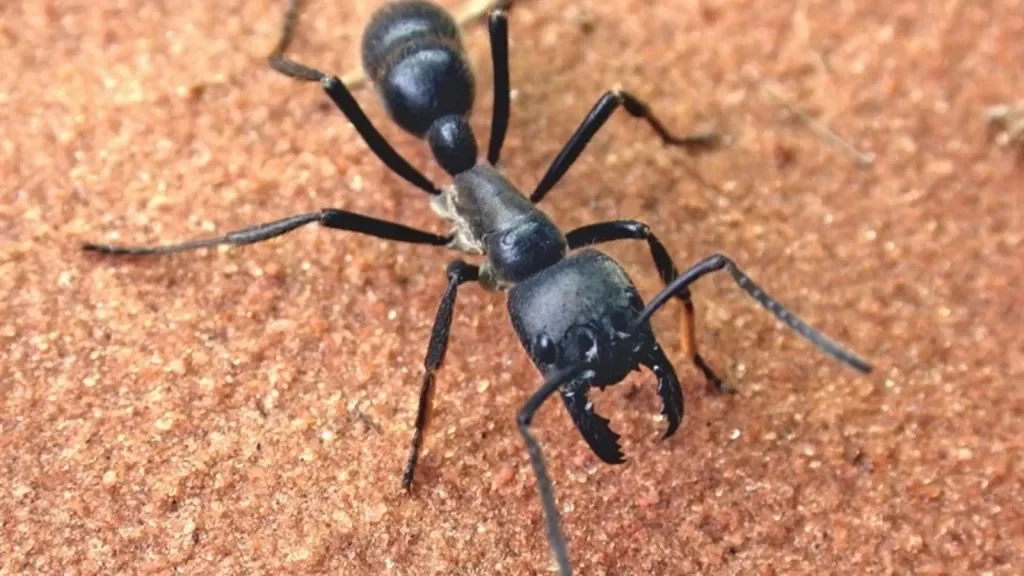
Amazonian Giant Ant
The Amazonian giant ant (Dinoponera gigantea) is one of the world’s largest ant species, with workers reaching lengths of 3.6 centimeters, or about 1.4 inches. An ant that size would be difficult to overlook, but its unusual social life is just as interesting as its appearance. These ants belong to a group whose colonies function without a physically specialized queen (Lenhart et al., 2013).
Dinoponera is an exclusively South American genus. A taxonomic revision published in 2021 recognized eight species, all of which occur in Brazil. Although their size makes them conspicuous, distinguishing these species can require careful examination. Researchers compare features such as body sculpture, hairs, and the shapes of particular body parts. Even giant ants can present difficult identification problems, and their classification has changed as scientists have examined more specimens (Dias & Lattke, 2021).
Amazonian giant ants establish underground nests, often near the bases of trees. Their nests can have several entrances, with as many as eight reported. A colony may also occupy more than one nearby nest, an arrangement called polydomy. Published observations summarized in a review report colonies of roughly 30–96 workers. Their impressive individual size therefore does not mean that they live in enormous colonies (Lenhart et al., 2013).
These ants are opportunistic omnivores. They hunt live prey, scavenge dead animals, and gather fruits and seeds. In a northern Brazilian study, fruits and seeds accounted for approximately 22 percent of the food items collected. Animal foods included insects, spiders, and snails. Workers carried smaller items and dragged larger ones through the leaf litter (Fourcassié & Oliveira, 2002).
Workers forage alone rather than recruiting nestmates to food. Researchers generally followed them within about 10 meters, or 33 feet, of their nests, although observations suggested occasional longer journeys. Individual ants repeatedly searched in preferred directions. Successful trips commonly lasted 30–60 minutes, while some excursions continued for up to three hours (Fourcassié & Oliveira, 2002).
During daytime observations, activity peaked around dawn and dusk and declined with increasing temperature. The researchers also saw workers returning at sunrise and departing at sunset, suggesting some nighttime activity. Neighboring colonies sometimes met in ritualized territorial contests. Together, these observations reveal a forest floor divided into familiar searching areas and contested boundaries (Fourcassié & Oliveira, 2002).
Their reproductive system is particularly unusual. In Dinoponera, the queen caste has been lost, and reproduction is performed by workers called gamergates. A gamergate is a mated reproductive worker, rather than a separate physical type of ant. Workers have reproductive potential, but dominance relationships ordinarily restrict the reproductive role to one individual (Dias & Lattke, 2021).
Being queenless therefore does not mean that every worker reproduces equally. Research on the genus describes hierarchies in which high-ranking workers compete for reproductive status. This makes Dinoponera useful for understanding how reproductive roles can be regulated through interactions among workers, even without a morphologically distinct queen (Dias & Lattke, 2021).
New colonies can form through fission: a reproductive female leaves with a group of workers to establish another nest. This allows the new colony to begin with an existing workforce. Colony reproduction therefore involves a division of the social group, as well as the production of individual offspring (Lenhart et al., 2013).
Foraging alone and living socially are entirely compatible in these ants. A worker searching through fallen leaves is still gathering resources for a colony. Their combination of large bodies, individual foraging, and worker-based reproduction illustrates how much variety exists within the seemingly familiar world of ants.
.
References:
Ross, Heather. (September 23, 2024) The 10 largest ants in the world AZ Animals
https://a-z-animals.com/animals/ant/ant-facts/largest-ants-in-the-world/
Fourcassie, Vincent. Oliveria, Paula S. (December 2002) Foraging ecology of the giant Amazonian ant Dinoponera gigantea (Hymenoptera, Formicidae, Ponerinae): activity schedule, diet and spatial foraging patterns Journal of Natural History Volume 36, Issue 18, pp. 2211-2227, 17 pp.
https://ui.adsabs.harvard.edu/abs/2002JNatH..36.2211F/abstract
(September 27, 2026) This Giant Amazonian Ant is more than 3 cm long: What makes it unusual
The Indian Express