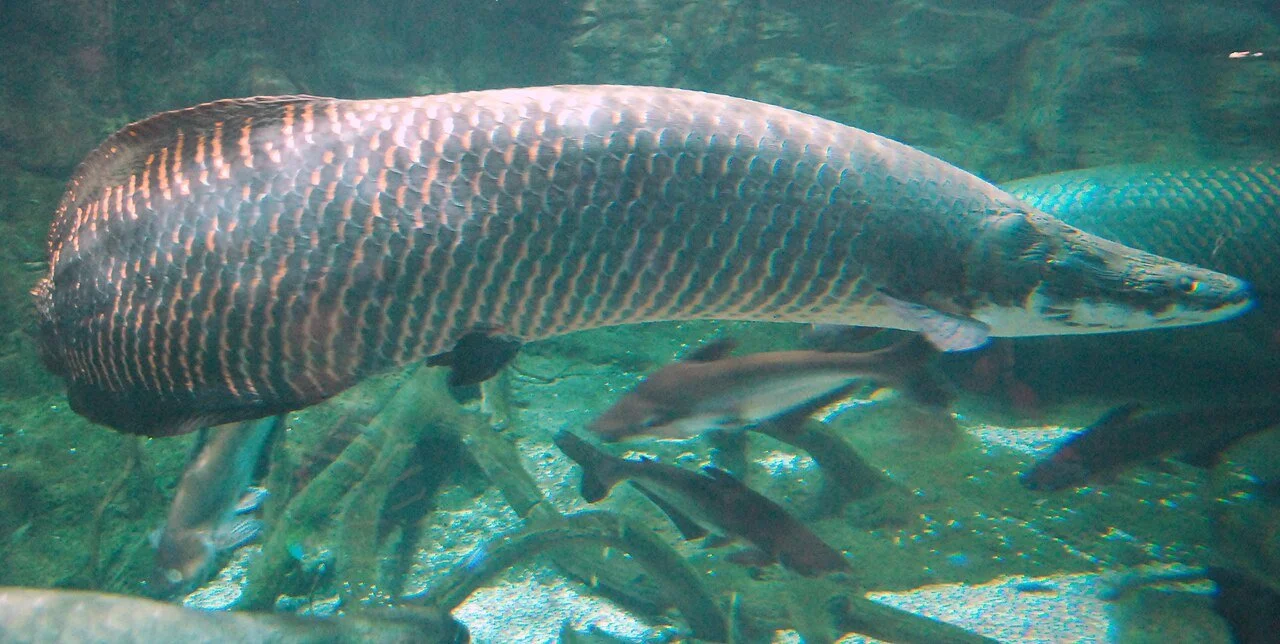
Arapaima
Arapaima gigas Wikipedia
The arapaima is one of the most remarkable fish in the world. There are four recognized species: Arapaima agassizii, Arapaima leptosoma, Arapaima mapae, and Arapaima gigas. The largest species, Arapaima gigas, is the largest fish in the Amazon Basin and one of the largest freshwater fish on Earth, capable of reaching lengths of up to fifteen feet.
Arapaimas inhabit rivers, floodplain lakes, and seasonally flooded forests throughout the Amazon Basin. Unlike most fish, arapaimas regularly rise to the surface to breathe air. This adaptation allows them to survive in warm, oxygen-poor waters where many other fish struggle. To obtain additional oxygen, arapaimas gulp air into a highly modified swim bladder that functions much like a primitive lung (Shedd Aquarium). Scientists believe that the lungs of terrestrial vertebrates may have evolved from structures similar to these modified swim bladders.
The ability to breathe air gives arapaimas a significant advantage over other fish. In oxygen-poor environments, many fish become sluggish because their gills cannot extract enough oxygen from the water. Arapaimas, however, can continue to swim actively and even burst into rapid acceleration when pursuing prey (Smithsonian's National Zoo and Conservation Biology Institute). This adaptation makes them formidable predators.
Although arapaimas are powerful hunters, they are technically omnivorous. Their diet includes fish, crustaceans, insects, and occasionally fruits and seeds that fall into the water (Shedd Aquarium). They are ambush predators, relying on sudden bursts of speed to capture prey near the surface.
Another remarkable feature of the arapaima is its armor-like scales. These scales are exceptionally tough and flexible, providing protection against predators such as piranhas. The scales consist of a hard outer layer supported by a softer inner layer, allowing them to resist punctures while remaining flexible enough for swimming.
Arapaimas reproduce during the dry season, when water levels are low. The parents construct nests in shallow water, where the female lays her eggs. After the eggs hatch, both parents help protect the young. The male often carries the fry around his head, guarding them from predators as they grow.
For thousands of years, indigenous peoples and local communities have relied on arapaimas as a source of food. Their large size means that a single fish can provide a substantial amount of meat. However, overfishing has reduced populations in some areas of the Amazon. As a result, many regions now regulate arapaima harvests in an effort to protect wild populations.
Due to the fact that arapaimas grow rapidly and can reach impressive sizes, scientists and fish farmers have become interested in raising them in aquaculture systems. Their fast growth and ability to breathe air make them promising candidates for freshwater aquaculture (Schaefer, 2012). Researchers continue to study whether arapaimas can be farmed sustainably while minimizing impacts on wild populations.
The arapaima is more than simply the largest fish in the Amazon. It is a living example of how evolution can produce extraordinary adaptations to challenging environments. From its lung-like swim bladder to its armor-like scales, the arapaima demonstrates the incredible diversity of life found within the Amazon rainforest.
References:
Arapaima Shedd Aquarium
https://www.sheddaquarium.org/animals/arapaima
Arapaima Smithsonian’s National Zoo and Conservation Biology Institute
https://nationalzoo.si.edu/animals/arapaima
Schaefer, Fabian. Kloas, Werner. Wurtz, Sven. (November 2, 2012) Arapaima a candidate for intensive freshwater culture Global Seafood Alliance
https://www.globalseafood.org/advocate/arapaima-candidate-for-intensive-freshwater-culture/