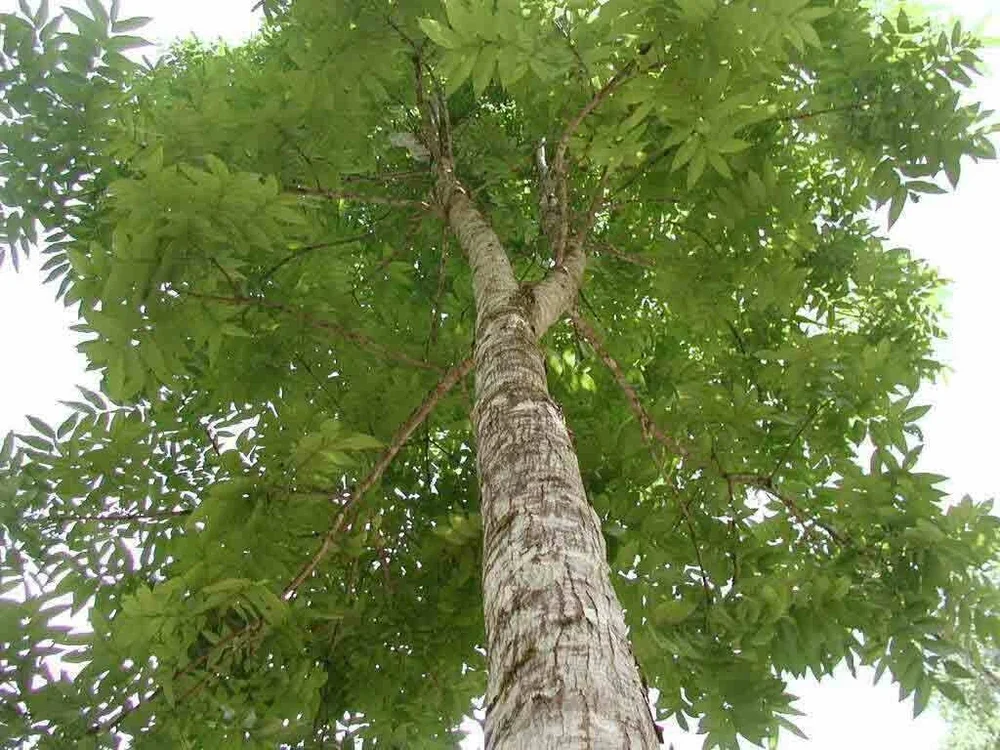
Big-Leaf Mahogany
All Species Wiki
Big-leaf mahogany (Swietenia macrophylla) is one of three species of true mahogany in the genus Swietenia and the only one native to the Amazon rainforest. Its natural range extends from southern Mexico through Central America into tropical South America, including parts of Brazil, Bolivia, and Peru. Although associated with the Amazon, the species therefore depends on conservation efforts across numerous countries. It produces some of the region’s most commercially valuable timber and has a long history of exploitation for international markets (Robbins, 2000). Mahogany Matters
Furniture makers prize mahogany for its attractive coloration, durability, and ease of working. Its stability, which helps finished pieces retain their shape, also contributes to its popularity. These qualities make it useful for fine furniture, cabinetry, veneers, and decorative woodwork. Its commercial appeal consequently involves both its appearance and the practical qualities that allow craftspeople to turn it into lasting products (Robbins, 2000). Mahogany Matters
Unfortunately, the qualities that make mahogany desirable have also encouraged its overexploitation. In 2023, the International Union for Conservation of Nature (IUCN) changed big-leaf mahogany’s classification from Vulnerable to Endangered. Its population has declined by at least 60% over the past 180 years because of unsustainable harvesting and the conversion of its forest habitat to agricultural and urban land. These pressures compound one another: logging removes trees from surviving forests, while land conversion eliminates habitat where the species could otherwise continue growing (IUCN, 2023). IUCN’s assessment announcement
The ecological consequences of mahogany exploitation can extend beyond the removal of individual trees. Roads built to transport valuable timber can open previously remote forests to settlement and agricultural clearing. The effects can therefore spread beyond the original logging site, threatening other plants and animals that share the forest. Conserving mahogany also means considering how people gain access to the places where it grows (Robbins, 2000). Mahogany Matters
Demand for mahogany continues in markets including the United States, Western Europe, and China. Despite national and international protections, illegal logging and trade remain serious problems. Climate change presents an additional concern, with models suggesting that some areas of its current habitat could become unsuitable. The IUCN identifies stronger management of protected areas and greater resources to combat illegal timber trading as urgent priorities. Protecting big-leaf mahogany requires addressing both the demand that drives destructive harvesting and the loss of the forests where it lives. Its survival depends on ensuring that its commercial value does not come at the expense of its continued existence in the wild (IUCN, 2023). IUCN’s assessment announcement
References:
Robbins, Christopher S. (October 2000) Mahogany Matters: The U.S. Market for Big-Leafed Mahogany And Its Implications For the Conservation Of the Species Traffic North America
Big leaf mahogany IUCN Redlist
https://www.iucnredlist.org/species/32293/68104718
Goulding, Michael Barthem. Ronaldo, Ferreira Efrem (2003) The Smithsonian Atlas of the Amazon
Gomez-Cifuentes, Andres. Vespa, Natalia. Semmartin, Maria. Zurito, Gustavo. (October 2020) Canopy cover is a key factor to preserve the ecological functions of dung beetles in the southern Atlantic Forest Applied Soil Ecology Volume 154
https://www.sciencedirect.com/science/article/abs/pii/S0929139319314295