Black Flies
Purdue University
https://extension.entm.purdue.edu/publichealth/insects/blackfly.html
Black flies are small, stout-bodied flies belonging to the family Simuliidae. More than 2,400 living species are recognized worldwide (Adler, 2026). They occur on every continent except Antarctica and are closely associated with rivers and streams because their young develop in flowing water. Although best known for their irritating bites, black flies spend an important part of their lives as aquatic filter feeders (Government of Canada).
Black fly larvae are adapted to staying in place despite the current. They produce silk and use tiny hooks at the rear of their bodies to attach themselves to submerged rocks, vegetation, and other surfaces. Silk strands also act as safety lines while larvae move to suitable feeding locations. Once attached, they extend fanlike structures near their mouths to collect food carried by the water. Their diet includes bacteria, algae, and small particles of organic matter. The current therefore provides both a challenge and a steady supply of food (Illinois Department of Public Health; Government of Canada).
The larvae eventually develop into pupae underwater. When the adult flies emerge, they can reach the surface inside a bubble of air and then fly away. This transition takes them from an aquatic life collecting suspended particles to a terrestrial life searching for mates and food (Government of Canada).
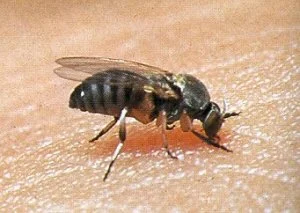
Both male and female black flies feed on nectar, but females of most species also take blood meals to support egg production. Depending on the species, they may feed on birds, humans, or other mammals. Their mouthparts cut into the skin, and they consume the blood that collects at the wound. Bites can cause pain, itching, inflammation, and swelling; some people also experience serious allergic reactions (Illinois Department of Public Health).
Large numbers of black flies can pose a substantial threat to livestock. Repeated attacks cause distress, disrupt feeding, and can reduce milk production and weight gain. Blood loss can harm animals, but fatal attacks are often associated with toxemia and shock caused by the bites. Dense swarms can also obstruct animals’ airways (Livestock Veterinary Entomology).
The most important human disease transmitted by black flies is Onchocerciasis, commonly called river blindness. It is caused by Onchocerca volvulus, a parasitic nematode, or roundworm, passed to humans through the bites of infected black flies. Infection can cause severe itching, skin damage, and permanent blindness. Onchocerciasis is one form of filariasis, a group of infections caused by filarial worms (World Health Organization).
However, encountering black flies does not automatically mean encountering river blindness. Transmission is restricted to particular regions where the parasite and suitable fly vectors occur. Most infections occur in Africa, while the remaining transmission area in the Americas lies along the Brazil–Venezuela border. This makes black flies relevant to both the freshwater ecology and human health of the Amazon region (World Health Organization).
References:
Adler, P. H. (2026). World blackflies (Diptera: Simuliidae): A comprehensive revision of the taxonomic and geographical inventory [2026]. Clemson University. https://biomia.sites.clemson.edu/pdfs/blackflyinventory.pdf
Black Flies (“Buffalo Gnats”) Illinois Department of Public Health
Black Fly Livestock Veterinary Entomology
https://livestockvetento.tamu.edu/insectspests/black-fly-simuliidae/
Aupalee K, Saeung A, Srisuka W, Fukuda M, Streit A, Takaoka H. Seasonal Filarial Infections and Their Black Fly Vectors in Chiang Mai Province, Northern Thailand. Pathogens. 2020 Jun 25;9(6):512. doi: 10.3390/pathogens9060512. PMID: 32630410; PMCID: PMC7350311.
https://pmc.ncbi.nlm.nih.gov/articles/PMC7350311/
Insects: Black flies Government of Canada
Khanzadeh, F., Maleki-Ravasan, N., Adler, P.H. et al. First report of filarial nematodes in the genus Onchocerca infecting black flies (Diptera: Simuliidae) in Iran. Sci Rep 13, 14585 (2023). https://doi.org/10.1038/s41598-023-41890-z
(December 4, 2025) Onchocerciasis World Health Organization
https://www.who.int/news-room/fact-sheets/detail/onchocerciasis?utm