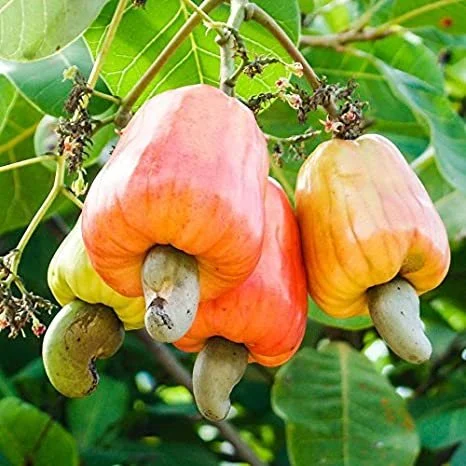
The cashew tree (Anacardium occidentale) is a member of the family Anacardiaceae, which also includes mangoes, pistachios and poison ivy (Toxicodendron radicans). Members of this family produce chemically related phenolic compounds, some of which can cause severe skin irritation or allergic contact dermatitis.
Cashews are often said to contain urushiol, the allergen associated with poison ivy. More precisely, the shell contains a caustic resin known as cashew nutshell liquid, or CNSL. Natural CNSL consists primarily of anacardic acids, cardol and smaller amounts of cardanol. These compounds are chemically related to urushiol and can produce similar skin reactions. The irritating liquid is concentrated within a honeycomb-like layer of the shell surrounding the edible seed.
The cashew apple
What appears to be the fruit of the cashew tree is actually composed of two distinct structures. The colorful, pear-shaped portion is known as the cashew apple. It is a pseudofruit formed mainly from the enlarged and fleshy flower stalk, or peduncle. The kidney-shaped structure hanging beneath it is the plant’s true fruit, and the edible cashew seed is enclosed inside that fruit.
Cashew apples are juicy, aromatic and rich in vitamin C. They can be eaten fresh or processed into juice, preserves, syrup, vinegar and alcoholic drinks. However, the fruit softens and begins deteriorating very rapidly after harvest. Consequently, cashew apples are commonly consumed or processed near the places where they are grown but are rarely exported as fresh fruit (Gutiérrez-Paz et al., 2024).
This creates an unusual situation in which the large and colorful cashew apple is less familiar internationally than the single seed attached beneath it. Much of the pseudofruit may be discarded in regions where cashews are grown primarily for the international nut market.
Why cashews are not sold in their shells
The edible cashew seed itself does not naturally contain the reservoir of caustic liquid found in the surrounding shell. However, the seed can become contaminated with shell liquid if the fruit is opened improperly. Cashews therefore require considerably more processing than nuts that consumers can safely crack at home.
Processing methods vary, but cashew fruits are generally dried and then treated with steam, hot oil or roasting heat. This treatment makes the shell easier to open and alters or removes much of its caustic liquid. Workers or machines then crack each shell and extract the seed without allowing the shell liquid to contaminate it. The seed is subsequently dried, peeled, inspected and sometimes roasted again.
Workers who shell cashews by hand can suffer burns, blisters and contact dermatitis, particularly when appropriate equipment is unavailable. Protective gloves and mechanized shelling can reduce direct exposure, although gloves must be made from material capable of resisting the oily shell liquid. Studies of cashew-processing workers have found that employees involved in shelling and peeling report particularly high levels of skin problems.
This hazardous shell is why cashews are almost never sold to consumers in the shell. Even cashews marketed as “raw” have normally received steam or another heat treatment during processing. In this context, “raw” means that the seed has not undergone the additional roasting that produces the flavor and color of commercially roasted cashews; it does not mean that it was taken untreated from the tree.
Cashew nutshell liquid is not simply discarded. Its compounds are used to manufacture resins, coatings, adhesives, lubricants and friction materials, including some brake and clutch components. Thus, a defensive chemical that makes cashews difficult and potentially hazardous to process has also become a valuable industrial raw material.
References:
Stierwalt, Sabrina (January 26, 2020) What do cashews, mangoes, and poison ivy have in common? Scientific American
https://www.scientificamerican.com/article/what-do-cashews-mangoes-and-poison-ivy-have-in-common/
Gutierrez-Paz, Carina. Rodrigez-Monero, Marina-Contstanza. Hernandez-Gomes, Maria-Soladad. Fernandez-Trujillo, Juan Pablo. (July 26, 2024) The Cashew Pseudofruit (Anacardium occidentale): Composition, Processing Effects on Bioactive Compounds and Potential Benefits for Human Health Foods
https://pmc.ncbi.nlm.nih.gov/articles/PMC11311269/