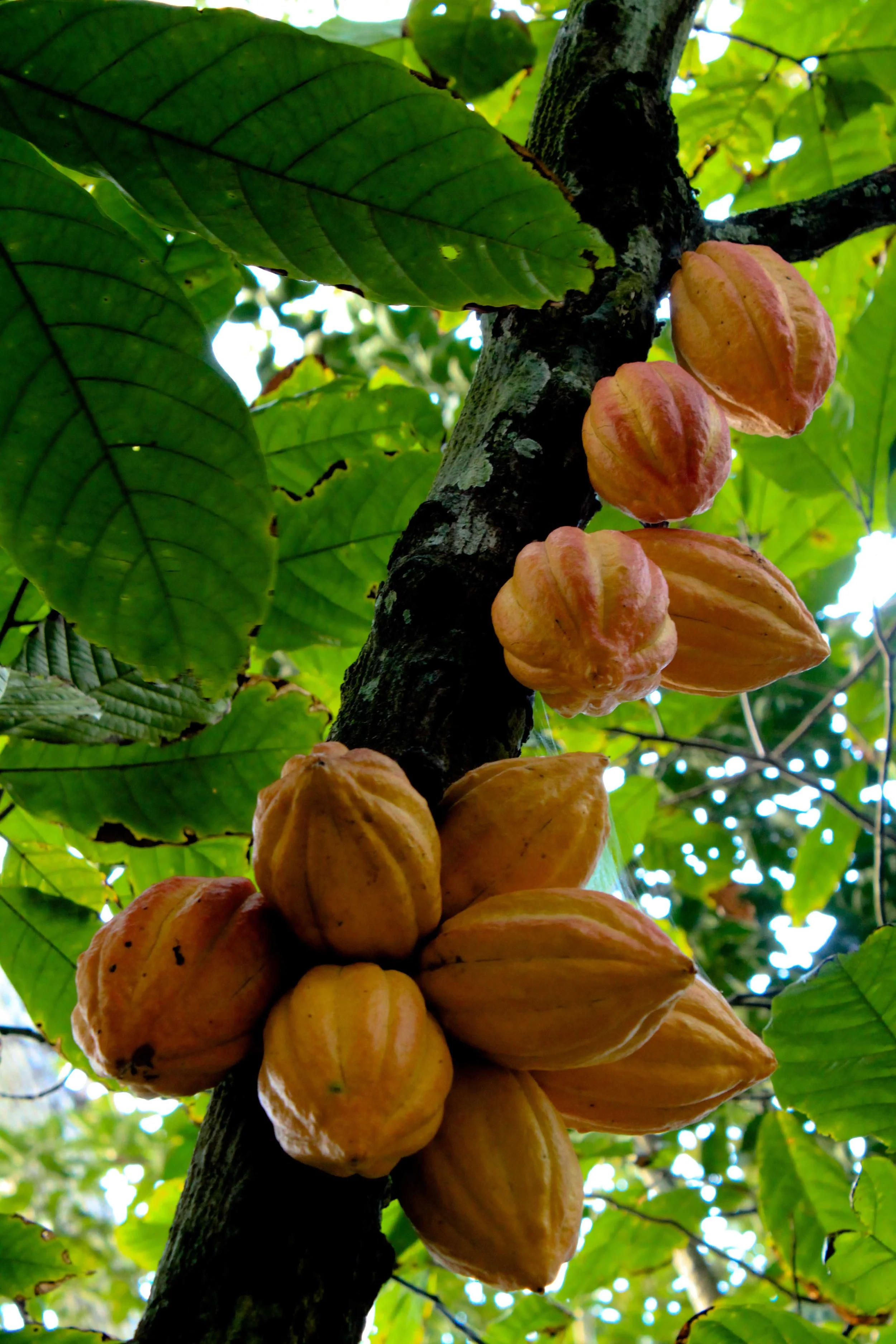
Cocoa Tree
The cocoa tree (Theobroma cacao), also called cacao, is a tropical evergreen that produces the seeds used to make chocolate. It grows well in warm, humid conditions and can be cultivated beneath the shade of taller rainforest trees. Its fruits, known as pods, grow directly from the trunk and larger branches. Inside each pod are numerous seeds, commonly called cocoa beans, surrounded by sweet pulp. (Rainforest Alliance, 2014)
Although cacao is best known for chocolate, its fresh pulp tastes quite different. The white pulp surrounding the seeds is sweet and slightly tangy, with a flavor sometimes compared to lychee or mango. It can be eaten fresh or used to make juice. The raw seeds themselves are bitter and earthy, lacking the familiar flavor of a finished chocolate bar. (Vishnefske, 2022)
Developing chocolate’s flavor requires several processing steps. After the pods are opened, the seeds are removed and fermented with their surrounding pulp still attached. Fermentation helps reduce bitterness and develop flavor. The seeds are then dried and roasted before their shells are removed, leaving pieces known as cocoa nibs. Grinding the nibs produces a thick paste called cocoa liquor. Despite its name, this material is not an alcoholic beverage. (Rainforest Alliance, 2014)
The cocoa liquor undergoes further processing to become a finished chocolate bar. Sugar is typically added, and the mixture is refined and continuously mixed in a process called conching, which improves its flavor and texture. The chocolate is then carefully heated and cooled during tempering, helping it set properly. The transformation from fresh cacao to chocolate therefore involves much more than simply sweetening the raw seeds. (Rainforest Alliance, 2014)
Cacao naturally contains theobromine, an alkaloid that accumulates in its developing seeds. Zheng and colleagues found particularly high concentrations in the cotyledons, the seed leaves that store nutrients for the developing seedling. They also found that much of the theobromine in the seeds was produced within the cotyledons themselves. This concentration is consistent with a possible role in protecting the seeds, although the study does not establish that theobromine evolved specifically to discourage seed predators while allowing animals to disperse them. (Zheng et al., 2004)
Theobromine also helps explain why chocolate is suitable for humans but dangerous to some other animals. Dogs break down theobromine more slowly than people, allowing its effects on the heart and nervous system to persist longer. Humans metabolize it more quickly and generally tolerate the amounts normally present in chocolate. However, tolerance varies between species, and an animal’s ability to eat cacao does not necessarily mean that it evolved a specific adaptation to this plant. (U.S. Food and Drug Administration, 2024)
References:
Vishnefske, Jason (September 5, 2022) The cacoa fruit and its unique taste Santa Barbara Chocolate
(July 31, 2014) Chocolate: The journey from beans to bar Rainforest Alliance
Meng, Cheng Chia. Jalil, Abbe Maleyki Mhd. Ismail, Amin. (January 5, 2009) Phenolic and Theobromine Contents of Commercial Dark, Milk and White Chocolates on the Malaysian Market Molcules
https://pmc.ncbi.nlm.nih.gov/articles/PMC6254055/
Zheng, Xin-Qiang. Koyama, Yoko. Nagai, Chifumi. Ashihara, Hiroshi. (April 16, 2004) Biosynthesis, accumulation and degradation of theobromine in developing Theobroma cacao fruits Plant Physiol
https://pubmed.ncbi.nlm.nih.gov/15128023/
Lemus, Alan (July 17, 2023) Discover Which Animals can Eat Chocolate (And Which Ones can’t) Animals AZ
https://a-z-animals.com/blog/discover-which-animals-can-eat-chocolate-and-which-ones-cant/