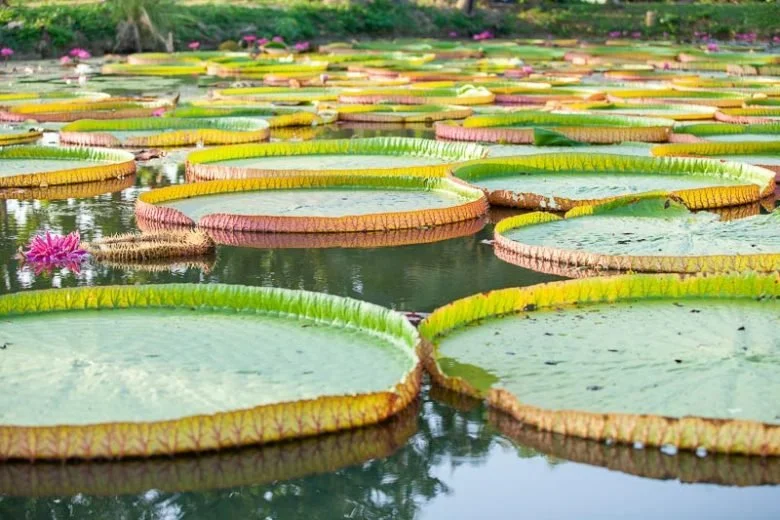
Giant Water Lilies
Victoria Amazonica Gardenia
Giant water lilies belong to the genus Victoria. There are three recognized species, two of which are found in the Amazon Basin: Victoria amazonica, which occurs throughout much of the Amazon, and Victoria boliviana, which is found primarily in the southwestern Amazon. The third species, Victoria cruziana, occurs farther south in the Paraná-Paraguay River system. Among the largest aquatic plants in the world, giant water lilies are famous for their enormous floating leaves, spectacular flowers, and unique pollination strategy.
The leaves of giant water lilies are among the largest produced by any plant. Mature leaves commonly exceed 2 meters (6.5 feet) in diameter and float on the water's surface with raised rims around their edges. These upturned rims help prevent water from washing over the leaf while also adding structural support. The undersides of the leaves contain a network of thick veins that act like the framework of a bridge, providing strength while keeping the leaves relatively lightweight. Under favorable conditions, a mature leaf can support the weight of a small child, although doing so can damage the plant and is generally discouraged outside of controlled demonstrations.
The undersides of the leaves are armed with formidable prickles. Although these structures are often called spikes, botanists classify them as prickles, a term that can sound less intimidating than it really is. Sharp plant structures are classified according to their origin: thorns are modified branches, spines are modified leaves or leaf stipules (small structures located at the base of a leaf), and prickles are all other sharp outgrowths. While prickles are often smaller than spines, this is not always the case, as giant water lilies clearly demonstrate.
These prickles help protect the leaves from herbivores, but they also serve another purpose. As the giant leaves expand across the water's surface, they can impale neighboring aquatic plants, giving the water lilies a competitive advantage (PBS, 2022). Competition among plants is often surprisingly intense. While giant water lilies use mechanical means to suppress nearby vegetation, many other plants compete chemically by releasing compounds into the surrounding soil or water that inhibit the growth of potential competitors. This phenomenon is known as allelopathy and occurs in many ecosystems around the world.
Like many aquatic plants, giant water lilies thrive in calm or slow-moving water, including oxbow lakes, floodplain lakes, ponds, and sluggish river channels. Their broad floating leaves allow them to capture as much sunlight as possible while shading the water beneath them. This shade can make it more difficult for submerged plants to grow, providing yet another competitive advantage. During the rainy season, when floodwaters spread across the Amazon floodplain, giant water lilies can rapidly colonize newly inundated habitats.
The flowers of giant water lilies are nearly as remarkable as their leaves. They are among the largest flowers produced by any aquatic plant and are pollinated primarily by beetles. The flowers open during the evening and produce both heat and a strong fragrance that attracts beetles from considerable distances. On the first night, the flowers are white and function as female flowers. Visiting beetles enter the blossom, which then closes around them, trapping the insects until the following evening.
While imprisoned inside the flower, the beetles transfer pollen that they carried from another flower, allowing fertilization to occur. As the flower matures, it switches from its female stage to its male stage. When it reopens the following evening, the flower has turned pink and releases fresh pollen onto the beetles before allowing them to escape. The beetles then fly to another newly opened white flower, where the cycle begins again (Uppsala University). This two-stage flowering process greatly reduces the chances of self-pollination and increases genetic diversity within the population.
The giant water lily has fascinated scientists and the public for centuries. Its enormous leaves, unusual defenses, and intricate relationship with beetle pollinators demonstrate that plants can evolve highly specialized adaptations just as animals do. Although giant water lilies appear peaceful as they float serenely on the water's surface, they are highly competitive organisms that defend themselves, outcompete neighboring plants, and rely on an elaborate partnership with insects to reproduce successfully. They are among the most iconic plants of the Amazon and serve as a reminder that some of the rainforest's most remarkable species are found not only in its towering canopy but also in its rivers and wetlands.
References:
PBS. (July 21, 2022). How the Giant Water Lily Dominates Other Plants | The Green Planet. https://www.youtube.com/watch?v=tl3RVfz-KPM
Uppsala University. The Giant Water Lilies. https://www.uu.se/en/botanical-garden/our-plants-and-attractions/our-plants/the-giant-waterlilies