Passion Fruit
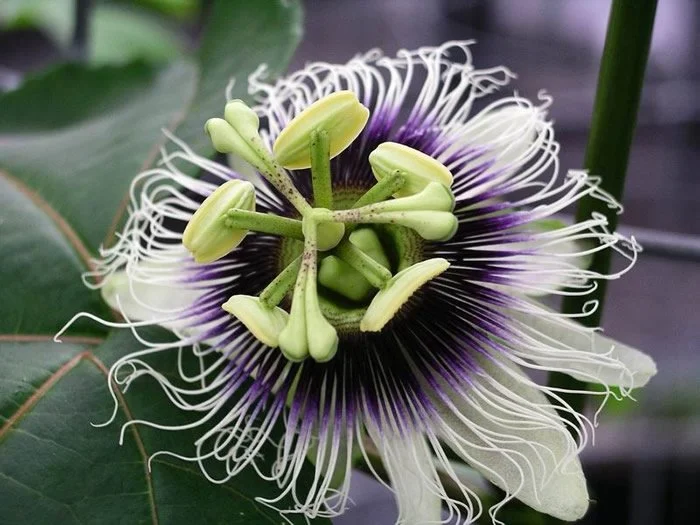
Passion fruit (Passiflora edulis) is a perennial climbing vine native to southern Brazil, Paraguay, and northern Argentina. It produces one of the most elaborate and recognizable flowers of any commercially grown fruit. The flower contains both male and female reproductive structures arranged around an elongated central stalk.
Surrounding the center of the flower is a structure called the corona. It consists of numerous slender, often brightly colored filaments radiating outward from the center. These filaments help guide visiting pollinators toward the flower’s reproductive structures (Brewer, 2019). The corona is responsible for much of the flower’s distinctive appearance.
Passion-fruit flowers are particularly well suited to pollination by large bees. Honeybees and carpenter bees both pollinate the crop, but carpenter bees can be more efficient because their larger bodies make contact with the flower’s anthers and stigmas more readily. Pollination has a direct effect on fruit quality. A passion fruit may contain as many as 350 seeds, and inadequate pollination can produce a hollow, lightweight fruit containing relatively little juice (BeeAware).
The vine produces a round or oval fruit with a tough outer rind. Inside are numerous edible seeds surrounded by aromatic, juicy pulp. Passion fruit has an intense combination of sweetness, acidity, and tropical aroma. However, the fruit can be extremely tart, particularly when it has not reached full ripeness. Purple passion fruit is generally allowed to become somewhat wrinkled before it is eaten; a perfectly smooth and plump fruit may not yet have developed its best flavor.
Fresh passion fruit is also less convenient to eat than many familiar supermarket fruits. It must be cut open and its seed-filled pulp scooped from the rind. The seeds are edible, but their abundance gives the pulp a texture that may be unfamiliar to American consumers. I can personally attest to both the fruit’s tartness and the difficulty of eating it in its fresh form.
Fresh passion fruit is not commonly stocked in the produce sections of mainstream supermarkets in the United States, although it can sometimes be found in specialty, international, and upscale grocery stores. American consumers are much more likely to encounter passion fruit in a processed form. Its pulp can be sweetened and made into juice, while its puree and concentrate are used in smoothies, flavored waters, cocktails, yogurt, candy, baked goods, and desserts.
Passion fruit is also frequently used as one component of a broader “tropical” flavor rather than being prominently advertised by itself. Its strong acidity and distinctive aroma allow a relatively small amount to add tartness and complexity to mixtures containing pineapple, mango, guava, orange, or other tropical fruits. Consequently, an American consumer may have tasted passion fruit numerous times without having purchased or eaten the fresh fruit.
This preference for processed passion fruit is not limited to individual products. Processed forms—including juice, pulp, and concentrate—were estimated to account for 57.6% of the global passion-fruit market in 2025. The food-and-beverage sector accounted for more than 59% of total market revenue. Demand in North America is particularly associated with smoothies, ready-to-drink beverages, tropical cocktails, flavored waters, and other products that use passion fruit as an ingredient. The entire global passion-fruit market was estimated to be worth $4.8 billion in 2025 and was projected to reach $6.9 billion by 2032 (Patil, 2025).
References:
Passionfruit Bee Aware
https://beeaware.org.au/pollination/pollinator-reliant-crops/passionfruit/
Brewer, Grace. (November 20, 2019) Passion Flowers: Ignite your Senses Discover the beautiful blooms and delicious delights of the Passion Flower. Royal Botanical Gardens Kew
https://www.kew.org/read-and-watch/passion-flowers-ignite-your-senses
Patil, Amol.(November, 2025) Passion Fruit Market Size, Share, and Growth Forecast 2025-2032 Persistence Market Research
https://www.persistencemarketresearch.com/market-research/passion-fruit-market.asp