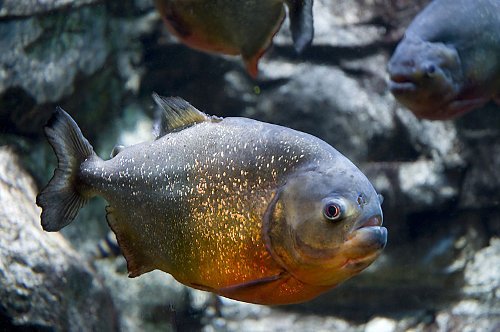
Piranha
Red Bellied Piranha (Pygocentrus nattereril) USGS
https://nas.er.usgs.gov/queries/FactSheet.aspx?speciesID=429
Few animals of the Amazon have inspired as much fascination and fear as the piranha. Popular culture often depicts piranhas as ruthless predators capable of stripping large animals to the bone in a matter of minutes. Movies, sensational news reports, and adventure stories have transformed these fish into icons of danger. However, the truth is far more complicated. Piranhas are not indiscriminate killers but a diverse group of fish that fill many ecological roles in South America's rivers and floodplains.
More than sixty species of piranhas inhabit the freshwater ecosystems of South America, with dozens occurring in the Amazon Basin (Britannica). They belong to the family Serrasalmidae, which also includes pacus and silver dollars. Although piranhas are found in rivers throughout much of tropical South America, they are especially abundant in the Amazon and Orinoco basins and in the rivers of the Guianas and the Paraná-Paraguay system.
Diversity and Distribution
The term "piranha" does not refer to a single species. Instead, it encompasses a variety of fish that differ significantly in appearance, behavior, and diet. The red-bellied piranha (Pygocentrus nattereri) is the species most familiar to the public, but numerous other species exist, including the black piranha (Serrasalmus rhombeus), the San Francisco piranha (Pygocentrus piraya), and the wimple piranha (Catoprion mento).
Piranhas inhabit a wide range of environments, including large rivers, oxbow lakes, flooded forests, swamps, and seasonally inundated floodplains. During the rainy season, much of the Amazon rainforest floods, creating vast temporary habitats where fish can feed among submerged trees. Many piranhas take advantage of this seasonal abundance, consuming fruits, seeds, insects, and smaller fish that become available in the flooded forest.
Teeth and Jaws
The feature for which piranhas are best known is undoubtedly their teeth. Their triangular teeth interlock like the blades of a pair of scissors, allowing them to slice through food with extraordinary efficiency. Unlike the teeth of mammals, piranha teeth are replaced in groups rather than individually. When one set wears out, an entire section of teeth may be replaced at once.
Different species have evolved teeth adapted to different diets. Species that consume fish possess razor-sharp cutting teeth, while species that eat nuts and seeds have stronger jaws designed to crush hard plant material. The black piranha possesses one of the strongest bites relative to body size of any bony fish.
Although their teeth appear terrifying, they are tools shaped by evolution to exploit a wide variety of food sources rather than weapons designed exclusively for attacking large animals.
Diet and Feeding Strategies
Contrary to popular belief, many piranhas are omnivores. Their diets include fish, insects, crustaceans, worms, fruits, seeds, and aquatic vegetation (Britannica). Some species rely heavily on scavenging, feeding on animals that have already died rather than actively hunting living prey.
Different species occupy different ecological niches:
Some species specialize in hunting fish.
Others consume insects and aquatic invertebrates.
Some feed heavily on fruits and seeds that fall into the water.
Certain species specialize in eating scales.
Others survive primarily by biting fins from larger fish.
The wimple piranha is particularly unusual because much of its diet consists of scales and fins taken from other fish. Fin feeding is remarkably sustainable because damaged fins can regenerate.
The red-bellied piranha, despite its fearsome reputation, is actually omnivorous. According to the Smithsonian's National Zoo and Conservation Biology Institute, it consumes fish, insects, crustaceans, and fruits.
Feeding Frenzies: Myth and Reality
The feeding frenzy is perhaps the most enduring piranha myth. While piranhas are certainly capable of feeding rapidly under the right conditions, such behavior is uncommon in nature.
One of the most famous stories involving piranhas comes from Theodore Roosevelt's 1913 expedition to Brazil. Roosevelt described piranhas as "the most ferocious fish in the world" after witnessing a group devour a cow placed in the water. His account helped establish the modern image of piranhas as savage predators.
However, the demonstration Roosevelt observed was highly artificial. Local fishermen had isolated the fish in a small area and deprived them of food beforehand, ensuring an unusually aggressive response (Greater Cleveland Aquarium, 2018). Under ordinary conditions, piranhas rarely display such behavior.
Most feeding frenzies occur during periods of environmental stress. In the dry season, shrinking rivers and ponds may trap fish in crowded pools where competition for food intensifies. Hunger and limited space can cause piranhas to behave far more aggressively than they would under normal circumstances.
Piranhas and Humans
Despite their fearsome reputation, attacks on humans are relatively uncommon. Most piranha bites occur under specific circumstances, including:
Droughts that concentrate fish into shrinking pools.
Disturbances near nests.
Competition for food.
Fishing activities.
The presence of blood or struggling animals in the water.
In many parts of South America, people regularly swim, fish, and travel through waters inhabited by piranhas without incident.
Nevertheless, piranhas should be treated with caution and respect. Their teeth are capable of inflicting serious injuries, and fishermen often exercise care when removing piranhas from nets or hooks.
Social Behavior
Many people imagine piranhas as solitary monsters lurking in dark water, but some species are actually social animals. Red-bellied piranhas often form schools containing dozens or even hundreds of individuals.
Scientists believe schooling behavior may serve multiple purposes. Schools can provide protection against predators, increase the efficiency of finding food, and reduce the risk faced by any individual fish. Interestingly, schooling does not necessarily indicate cooperative hunting. In some cases, piranhas may gather primarily because each fish is afraid of being attacked by predators—or even by other piranhas.
Piranhas communicate using sounds as well as body language. Researchers have documented barking, clicking, and croaking sounds associated with territorial disputes and aggressive encounters.
Reproduction and Life Cycle
During the breeding season, male piranhas establish territories and construct nests among aquatic vegetation. Females deposit thousands of eggs, which the males guard aggressively against predators.
The eggs hatch within a few days, and the young fish initially feed on tiny organisms before gradually transitioning to larger prey. Juvenile piranhas face numerous dangers, including predation by birds, larger fish, reptiles, and even adult piranhas.
Because of the high mortality faced by young fish, producing large numbers of eggs increases the likelihood that at least some offspring will survive to adulthood.
Predators of Piranhas
Although piranhas are predators, they are also prey. Numerous Amazonian animals feed on them, including:
Giant otters.
Black caimans.
River dolphins.
Herons and kingfishers.
Large catfish.
Arapaima.
Turtles.
Juvenile piranhas are particularly vulnerable, but even adults can fall victim to larger predators.
Ecological Importance
Piranhas play an essential role in maintaining the health of South American freshwater ecosystems. As predators, they help regulate populations of smaller fish and aquatic invertebrates. As scavengers, they remove dead animals from rivers and streams, recycling nutrients back into the ecosystem.
Species that consume fruits and seeds may also contribute to seed dispersal, helping maintain the biodiversity of flooded forests. Without scavengers such as piranhas, dead organisms would accumulate, and nutrients would move through ecosystems less efficiently.
Rather than being villains of the Amazon, piranhas are vital components of one of the most diverse ecosystems on Earth.
Conclusion
Piranhas are far more complex than the myths that surround them. Although they possess sharp teeth and powerful jaws, many species are omnivorous, herbivorous, or scavengers. Feeding frenzies are unusual events that occur primarily under exceptional circumstances, not the norm.
These fish occupy many ecological roles: predator, scavenger, prey, and even seed disperser. By understanding piranhas as they truly are rather than as they are portrayed in popular culture, we gain a deeper appreciation for the extraordinary complexity of the Amazon rainforest and its inhabitants.
References:
Piranha Britannica
https://www.britannica.com/animal/piranha-fish
(February 16, 2018) How a president propagated a piranha myth Greater Cleveland Aquarium
https://www.greaterclevelandaquarium.com/how-a-president-propagated-a-piranha-myth/
Red Bellied Piranha Smithsonian’s National Zoo and Conservation Biology Institute