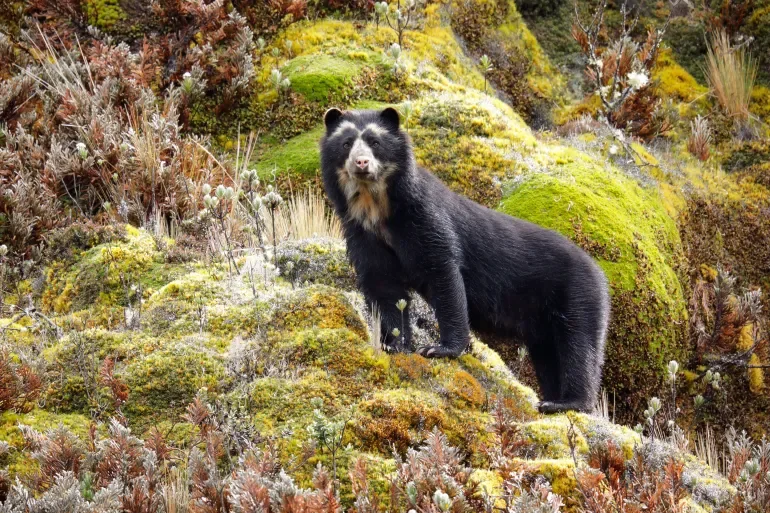
The spectacled bear (Tremarctos ornatus), also known as the Andean bear, is the only bear species native to South America and the last surviving member of the short-faced bear subfamily. While it is not found within the Amazon Basin itself, it inhabits the Andean cloud forests and montane forests that border the Amazon rainforest, making it an important part of the greater Amazon region. Spectacled bears range through countries such as Venezuela, Colombia, Ecuador, Peru, and Bolivia, where they inhabit environments ranging from dry forests to humid cloud forests at elevations of up to 15,000 feet. This species is currently listed as vulnerable by the International Union for Conservation of Nature (IUCN) due to habitat loss, fragmentation, poaching, and conflict with humans.
The spectacled bear gets its common name from the pale cream or yellowish markings around its eyes, which sometimes resemble eyeglasses. However, the markings vary greatly between individuals, and some bears may have markings extending across the chest and face while others have almost none at all. These unique patterns can help researchers identify individual bears in the wild. Spectacled bears are medium-sized compared to other bear species, typically growing 5 to 6 feet in length. Males are much larger than females and can weigh over 300 pounds, while females are usually considerably smaller.
Unlike many other bears, spectacled bears are highly herbivorous and are considered the second most vegetarian bear species after the giant panda. Much of their diet consists of bromeliads, palm hearts, fruits, cactus, orchids, bamboo, and other plant material. Bromeliads are especially important because spectacled bears often tear them apart to reach the nutritious inner portions. Although plant matter makes up most of their diet, spectacled bears are opportunistic omnivores and occasionally consume insects, rodents, birds, carrion, and small mammals. In some areas they have also been known to raid crops, which can bring them into conflict with farmers.
Spectacled bears are excellent climbers and spend a significant amount of time in trees. They often build tree platforms from broken branches that they use for resting and feeding. Their climbing ability allows them to access fruits and vegetation unavailable to many other large mammals. Due to the fact that they occupy high-altitude forests with steep terrain, spectacled bears are generally elusive and difficult for researchers to study in the wild.
Ecologically, spectacled bears play an important role as seed dispersers within Andean forests. By consuming fruit and spreading seeds across large distances, they help maintain plant diversity and forest regeneration. They may also influence vegetation by feeding heavily on certain plants such as bromeliads. As one of the largest mammals in the Andean cloud forests, they are an important component of these ecosystems.
One of the greatest threats facing spectacled bears is habitat fragmentation. Cloud forests are increasingly being cleared for agriculture, cattle ranching, mining, road construction, and human settlement. Due to the fact that spectacled bears require large territories and often move between different elevations in search of food, fragmented habitats can isolate populations and reduce genetic diversity. Climate change may also threaten the species by altering cloud forest environments and forcing suitable habitat farther upslope, reducing the amount of available territory.
Despite their large size, spectacled bears are generally shy and avoid humans whenever possible. Attacks on humans are rare, and the species has a reputation for being relatively docile compared to many other bears. Nevertheless, they are powerful wild animals capable of defending themselves if threatened or cornered.
Conservation efforts for spectacled bears include habitat protection, wildlife corridors connecting fragmented forests, anti-poaching measures, and education programs aimed at reducing conflict between bears and local communities. Protecting spectacled bears also helps conserve the biologically rich Andean cloud forests that support countless other species throughout the Amazon region.
References:
Andean Bear Smithsonian National Zoo and Conservation Biology Institute
https://nationalzoo.si.edu/animals/andean-bear
Andean Bear IUCN Redlist
https://www.iucnredlist.org/species/22066/123792952