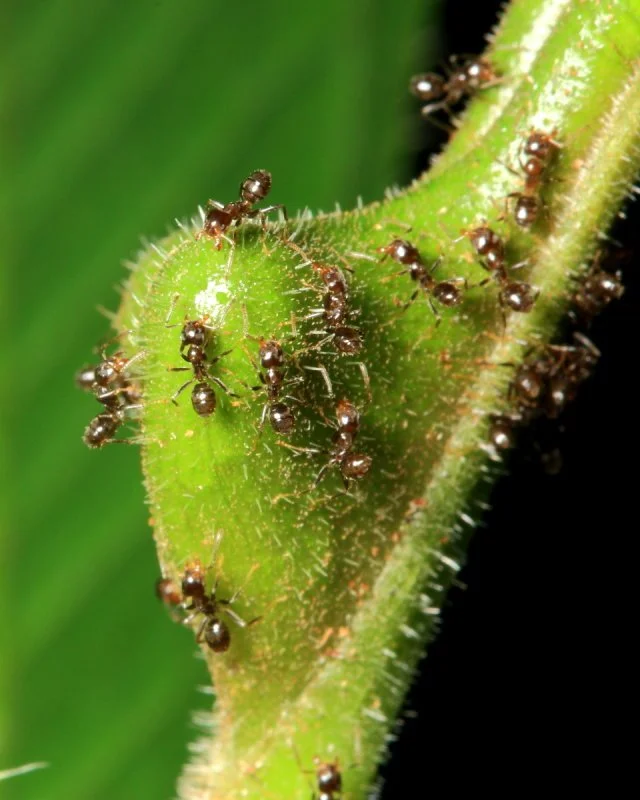
Azteca
Azteca is a genus of ants best known for its plant-protecting members, which form close relationships with trees of the genus Cecropia. These ants patrol their host trees, attack herbivores that try to munch on the leaves, and cut back encroaching vines. By removing competing vegetation and reducing damage from herbivores, the ants help protect the trees that provide their homes (Marting et al., 2018).
In exchange, Cecropia trees provide both room and board. The ants occupy hollow sections of the stems and branches, using these spaces to shelter their queens and raise their young. The trees also produce nutritious structures called Müllerian bodies near the bases of their leaf stalks. These are specialized food bodies rather than fruits, and they contain abundant glycogen, an energy-storing carbohydrate (Davidson, 2005).
A founding queen gains access to the tree by chewing through a weakened region of the stem. Inside, she finds space in which to establish her colony. The ants can remove soft internal tissue to enlarge their living quarters and connect neighboring hollow sections. The tree therefore serves as both a living nest and a source of food, with the colony occupying an increasingly extensive home as it develops. However, the association is not universal: some Cecropia species lack these resident ant partners. The familiar partnership represents an important ecological strategy rather than a rule applying to every member of either genus (Davidson, 2005).
This exchange is an example of mutualism, a relationship in which both partners benefit. The tree invests resources in housing and feeding the ants, while the ants defend the source of their food and shelter. Research on Azteca constructor found that colony growth and host-tree growth were synchronized. Most workers, young, and queens occupied the upper half of the tree, with the colony’s distribution following the growth of its foliage. The relationship is therefore dynamic: a growing tree provides additional resources and nesting space, while a growing colony supplies more potential defenders (Marting et al., 2018).
The ecological importance of this partnership may extend beyond the individual tree. Cecropia species are pioneers that colonize disturbed areas and help form secondary forests. As succession progresses, other tree species establish beneath their canopy. Research in central Amazonia has examined the growth of nine shade-tolerant tree species in secondary forests dominated by Cecropia or Vismia, demonstrating how conditions within these developing forests influence the next generation of trees (Jakovac et al., 2014).
Protecting a pioneer tree could consequently have effects that continue beyond its own survival. By reducing damage to Cecropia, Azteca ants may indirectly support the development of vegetation that provides growing conditions for later forest species. This broader contribution to forest recovery is an ecological inference from their protective role, rather than something established by the seedling study itself. It nevertheless illustrates how a small animal’s activities can connect to much larger changes in a plant community.
Herbivores are not the only intruders these ants confront. Some Azteca species can repel or divert army-ant raids. Azteca chartifex, for example, can prevent army ants from reaching its nests by diverting their columns away from the bases of occupied trees. This defense also benefits colonies of the social wasp Polybia rejecta that nest nearby (Le Guen et al., 2015).
The wasps provide protection in return. Birds sometimes attack Azteca nests to eat the developing ants inside, but nearby wasps can defend against these predators. Researchers in French Guiana found that A. chartifex nests associated with P. rejecta received protection from bird attacks. The two insects thus form another mutualism: the ants help keep army ants away, while the wasps help discourage birds. These partnerships show how Azteca ants participate in a network of relationships involving plants, predators, and other social insects (Le Guen et al., 2015).
References
Davidson, D. W. (2005). Cecropia and its biotic defenses. In C. C. Berg & P. F. Rosselli, Cecropia. Flora Neotropica Monograph, 94, 214–226.
Jakovac, A. C. C., Bentos, T. V., Mesquita, R. C. G., & Williamson, G. B. (2014). Age and light effects on seedling growth in two alternative secondary successions in central Amazonia. Plant Ecology & Diversity, 7(1–2), 349–358.
Le Guen, R., Corbara, B., Rossi, V., Azémar, F., & Dejean, A. (2015). Reciprocal protection from natural enemies in an ant-wasp association. Comptes Rendus Biologies, 338(4), 255–259.
Marting, P. R., Kallman, N. M., Wcislo, W. T., & Pratt, S. C. (2018). Ant-plant sociometry in the Azteca-Cecropia mutualism. Scientific Reports, 8, 17968.