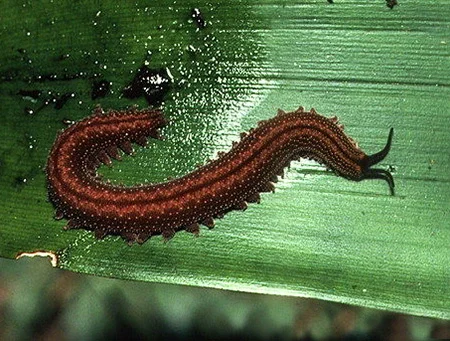
Velvet worms are unusual invertebrates belonging to the phylum Onychophora. Although they resemble caterpillars, they are neither insects nor true worms. Instead, they belong to an ancient evolutionary lineage closely related to arthropods and tardigrades. Their ancestors date back to the Cambrian Period, more than 500 million years ago, making them an important group for understanding the evolution of arthropods (Encyclopaedia Britannica; Understanding Evolution).
There are approximately 200 described species of velvet worms, divided into two living families: Peripatidae and Peripatopsidae. Peripatidae is primarily tropical and includes species inhabiting the Amazon rainforest, while Peripatopsidae is largely associated with southern landmasses such as Australia, New Zealand, South Africa, and Chile. Velvet worms generally inhabit moist environments, particularly leaf litter, rotting logs, and other sheltered areas of the forest floor (Australian Museum, 2025).
Velvet worms have soft, elongated bodies covered in tiny projections called papillae, which give them their characteristic velvety appearance. Depending on the species, they possess between 14 and 43 pairs of short, unjointed legs, each ending in small claws. Unlike arthropods, which have jointed limbs supported by an exoskeleton, velvet worms use fluid pressure to help move their legs. Their heads possess a pair of antennae, simple eyes, and specialized jaws used for feeding (Australian Museum, 2025).
Despite their harmless appearance, velvet worms are predators that feed on insects, spiders, and other small invertebrates. They hunt primarily at night, locating prey with their sensitive antennae. Once a suitable victim is found, the velvet worm fires streams of sticky slime from a pair of specialized structures near its mouth. The slime forms an adhesive network that entangles the prey and prevents its escape. The velvet worm then uses its sharp jaws to puncture the victim’s outer covering and releases digestive saliva that begins breaking down its tissues. The partially digested material is subsequently consumed (Mayer et al., 2015).
Velvet worms are particularly vulnerable to dehydration because their respiratory openings cannot close to prevent water loss. Consequently, they generally remain hidden in humid environments during the day and become active when conditions are sufficiently moist. Their dependence on humidity makes them vulnerable to forest clearing, habitat fragmentation, and changes in local climate (Australian Museum, 2025).
Reproduction varies considerably among velvet worm species. Some lay eggs, while others retain developing eggs inside their bodies until the young are ready to emerge. Still others give birth to live young that receive nourishment directly from their mothers during development. Certain species possess reproductive structures that function similarly to a placenta. In all cases, the young resemble miniature adults rather than passing through a distinct larval stage (Australian Museum, 2025).
Within the Amazon rainforest, velvet worms are part of the diverse community of small predators inhabiting the forest floor. By feeding on other invertebrates, they participate in the complex food webs of leaf litter and decaying wood. Their unusual anatomy, ancient evolutionary history, and specialized hunting behavior make them one of the rainforest’s most distinctive groups of invertebrates.
References
Encyclopaedia Britannica. Cambrian explosion.
https://www.britannica.com/science/Cambrian-explosion
Understanding Evolution, University of California, Berkeley. Onychophoran.
https://evolution.berkeley.edu/glossary/onychophoran/
Australian Museum. (2025, November 2). Velvet worm.
https://australian.museum/learn/animals/worms/velvet-worm/
Mayer, G., Oliveira, I. S., Baer, A., Hammel, J. U., Gallant, J., & Hochberg, R. (2015). Capture of prey, feeding, and functional anatomy of the jaws in velvet worms (Onychophora). Integrative and Comparative Biology, 55(2), 217–227.
https://doi.org/10.1093/icb/icv004