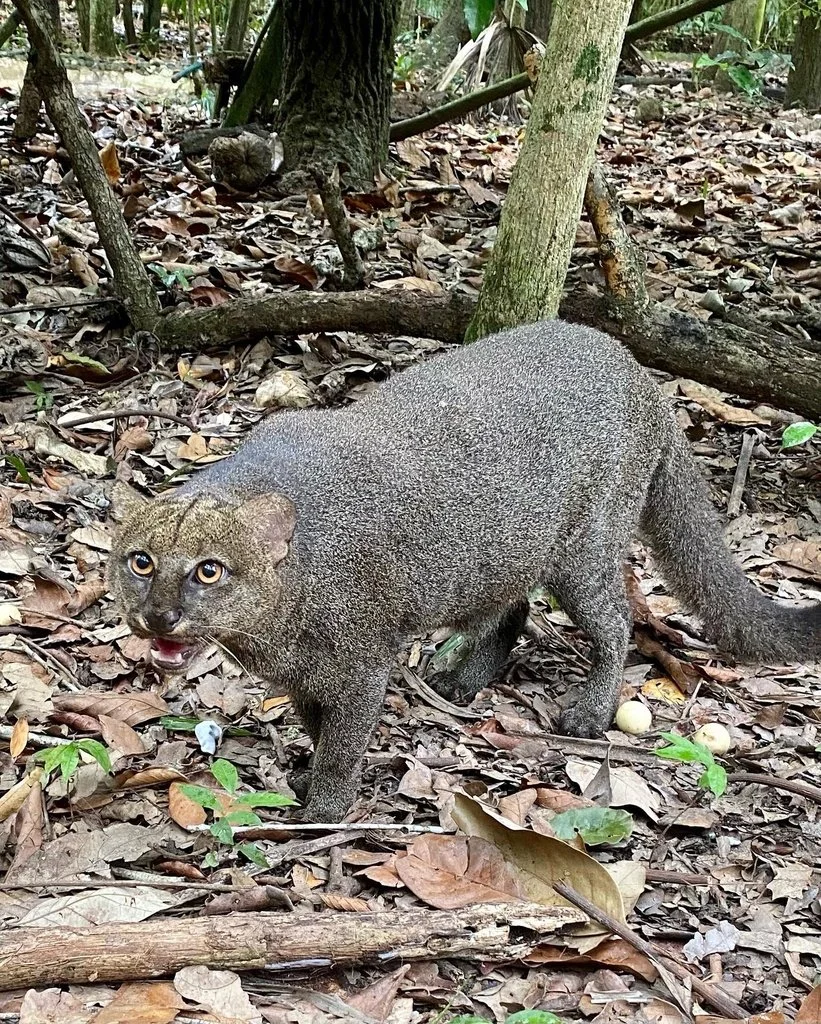
Jaguarundi
The Revelator
With its short legs, long body, rounded ears, and long tail, the jaguarundi (Herpailurus yagouaroundi) looks enough like an otter to have earned the nickname “otter cat.” Its closest relatives include the puma and the cheetah. Jaguarundis have short, mostly uniform coats that range from gray or nearly black to rusty red. The red form was once mistaken for a separate species, but kittens of different colors can occur in the same litter. Dark coats appear more frequently in rainforests, while red coats are more common in the dry scrublands of northeastern Brazil.
Jaguarundis range from Mexico to central Argentina. They inhabit the Amazon rainforest as well as savannas, wetlands, and dry thorn scrub. Across these different environments, what seems to matter is access to dense vegetation near the ground. A forest edge, for example, can have an open canopy with a thicket of shrubs underneath. Jaguarundis are often seen along these edges and in regrowing forest. They may favor such places, although a cat crossing a clearing in daylight is also easier to spot than one moving through the forest interior.
The jaguarundi does most of its hunting on the ground during daylight hours. Its prey includes small rodents, birds, and reptiles, but it can also climb and has been seen pursuing marmosets through the trees. Where jaguarundis share habitat with ocelots, the two cats do much of their hunting at different times. Ocelots are active mainly at night, so a jaguarundi hunting by day is less likely to encounter its larger neighbor. Competition with ocelots may help explain why one area supports fewer jaguarundis than another. Whether that competition has intensified enough to explain a recent population decline is a separate question.
The IUCN lists the jaguarundi as near threatened globally, while Brazil classifies it as vulnerable. Its use of forest edges raises an interesting conservation question. If clearing forest creates more edge, why would agricultural expansion harm this cat? Part of the answer lies in what remains between the fields. In Brazil and Belize, jaguarundis use wooded stream banks to travel through landscapes where farms alternate with patches of regrowing forest. In Colombia, researchers found that the cats avoided pastures and oil palm plantations. As fields expand, jaguarundis can lose both the thickets where they find cover and the wooded routes that let them reach the next patch.
References:
(August 8, 2024) Jaguarundi International Union for the Conservation of Nature
https://www.iucnredlist.org/species/9948/284507933
Jaguarundi Facts Big Cat Rescue
https://bigcatrescue.org/conservation-news/jaguarundi-facts
Jaguarundi IUCN/SSC Cat Specialists