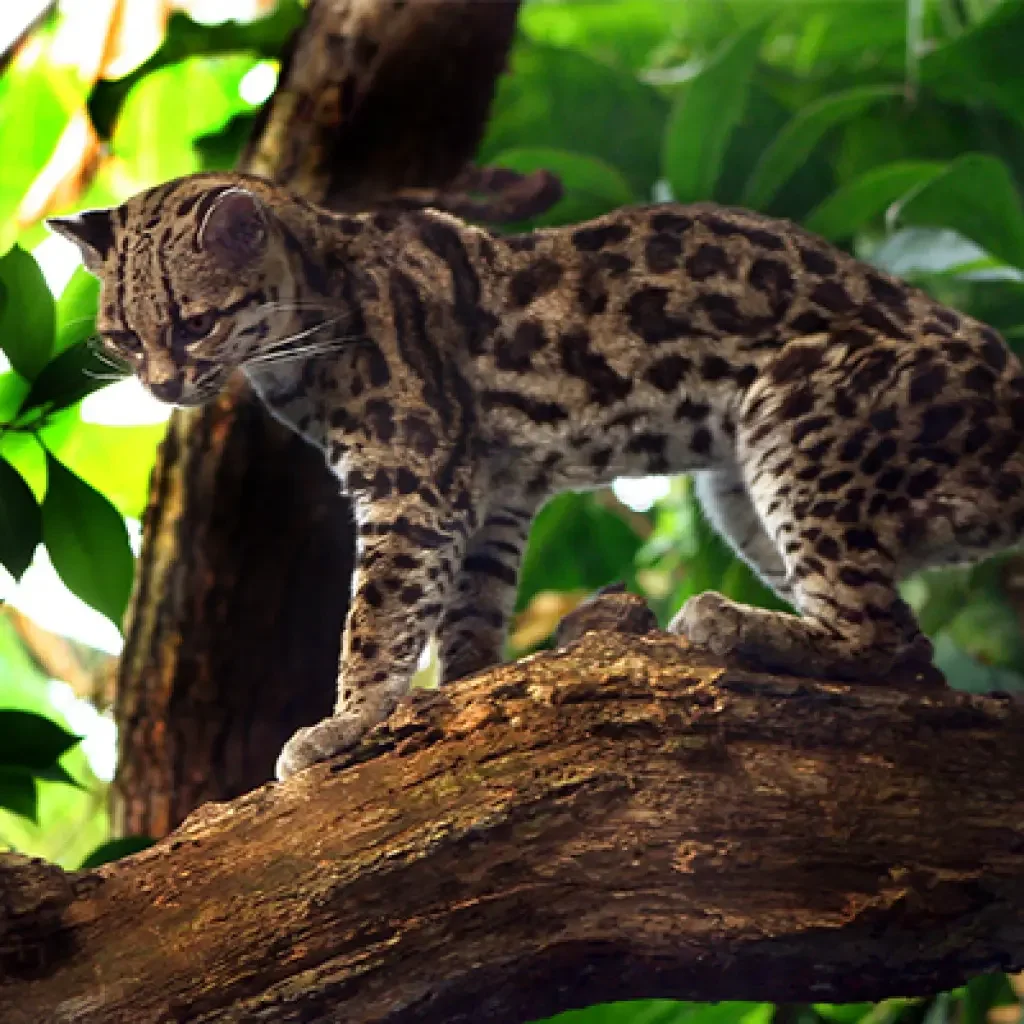
A margay (Leopardus wiedii) can climb headfirst down a tree trunk or hang from a branch by a single hind paw. The trick is in its ankles. A margay can turn its hind feet up to 180 degrees, allowing it to grip the bark with its claws as it climbs down. Its long tail acts as a counterweight when it moves along a branch. From base to tip, the tail can measure up to 70% of the distance from the cat’s nose to its rump.
With climbing skills like these, you might expect a margay to spend most of the night hunting in the canopy. Margays usually rest in trees, but much of their hunting takes place on the forest floor. They are mainly active at night, and small rodents make up the largest share of their diet. What they eat varies from place to place. In some areas, birds and lizards account for a substantial share of their prey. Margays also occasionally hunt small monkeys.
One of the most unusual accounts of a margay hunting comes from a forest reserve near Manaus in the Brazilian Amazon. One morning in 2005, researchers were watching eight pied tamarins (Saguinus bicolor) feed in a fig tree when they heard what sounded like a baby tamarin calling from a tangle of vines. The calls came from a margay. An adult male tamarin keeping watch climbed up and down the tree to investigate, then warned the others. A few minutes later, three of the monkeys were still feeding on figs while the lookout kept watch.
Eventually the researchers saw the margay climb down a trunk, leap onto a vine connected to the fig tree, and move toward the monkeys. This time the lookout gave a loud alarm call, and the whole group fled. The imitation had drawn the lookout’s attention, but the margay went away hungry. People living in the Amazon had already described wild cats imitating their prey. This encounter gave researchers a firsthand account of the behavior, though how often margays use it remains an open question (Calleia et al., 2009).
Margays live in several kinds of forest, including parts of the Amazon that flood seasonally. Even in open savannas, they tend to stay in strips of woodland along rivers. They can use patches of disturbed forest where enough trees remain, but clearing forest for crops and cattle pasture shrinks their habitat and splits it into isolated patches. Margays also reproduce slowly. A female usually gives birth to just one kitten, so a depleted population can take time to recover. The International Union for Conservation of Nature lists the margay as Near Threatened (de Oliveira et al., 2015).
References:
Margay Facts Big Cat Rescue
https://bigcatrescue.org/conservation-news/margay-facts
Boyle, Alan (July 8, 2010) Cat calls monkeys to their doom NBC News
https://www.nbcnews.com/science/cosmic-log/cat-calls-monkeys-their-doom-flna6c10403809
de Oliveira, T., Paviolo, A., Schipper, J., Bianchi, R., Payan, E. & Carvajal. (2015) Margay International Union for the Conservation of Nature Red List