Sandbox Tree
The sandbox tree (Hura crepitans) is known for being a particularly nasty tree. Animalogic’s Floralogic described it by saying that sandbox trees will stab you, poison you, and shoot you (Animalogic, 2022). I generally respect Animalogic, and while none of those claims is exactly false, I think the presentation hypes the tree up a little. So, how dangerous are the sandbox tree’s stabbing, poisoning, and shooting abilities really?
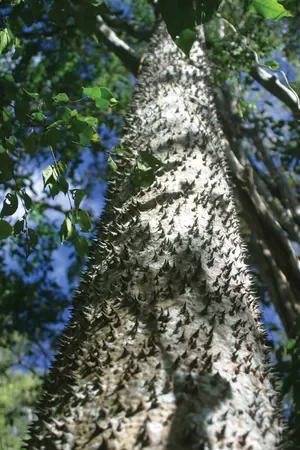
The first claim is that the sandbox tree can stab you. Its trunk is covered with sharp, conical projections commonly described as spines or prickles. Botanically, these terms have more specific meanings: thorns are modified stems or branches, while true spines are modified leaves or parts of leaves. Prickles are outgrowths from the outer tissues of the plant. Regardless of the terminology, the sandbox tree’s projections can be about an inch long and are certainly capable of giving someone a painful puncture wound.
However, they are also extremely obvious. Someone working in dense vegetation could certainly bump into the trunk accidentally, but under ordinary circumstances the projections are easy to see and avoid. Sharp plant structures are also hardly unusual. Roses, cacti, thistles, and many other plants have evolved ways of discouraging animals from touching or eating them. The sandbox tree has an unusually intimidating trunk, but its sharp projections are probably the least concerning of its notorious features.
Then there is the poison. The sandbox tree produces a milky latex containing irritating and toxic compounds. Contact with the sap can cause severe skin irritation, swelling, and blistering. Exposure to the eyes can cause serious injury and potentially temporary blindness, while ingestion can be dangerous.
Poisonous plants are extremely common, and it is probably impossible for even a specialized collection such as the Poison Garden at Alnwick to contain every one of them. Plants that cause damage merely through contact are less common than plants that must be eaten, but they are still familiar. Poison ivy is an obvious example, while giant hogweed can cause severe skin injury after exposure to its sap and sunlight.
The sandbox tree therefore does possess genuinely nasty sap. Of its famous characteristics, this is probably the one that deserves the most respect. However, even this does not make the sandbox tree completely unique among poisonous plants.
The most interesting claim is that the sandbox tree can shoot you. When its fruit dries, internal stresses build until the woody fruit suddenly splits apart with a loud crack. This is an example of ballistic seed dispersal rather than a defensive weapon. The tree is not trying to attack animals; it is trying to throw its seeds far enough away from the parent tree to improve their chances of survival.
Experiments on Hura crepitans found average initial seed velocities of about 43 meters per second, or roughly 96 miles per hour, with maximum velocities exceeding 70 meters per second, or about 157 miles per hour. This explains the frequently repeated claim that sandbox trees can launch their seeds at around 150 miles per hour.
Explosive seed dispersal itself is not especially unusual. Many plants use rapidly opening fruits to scatter their seeds. What makes the sandbox tree impressive is the combination of unusually high speed and comparatively large seeds. Sandbox tree seeds weigh roughly one gram each, far more than the tiny seeds launched by many other explosively dispersing plants.
At one gram and 150 miles per hour, a seed would carry roughly 2.2 joules of kinetic energy. That is enough to make a direct hit painful and potentially cause bruising or break the skin, particularly because the impact is concentrated over a small area. A strike to the eye could obviously be much more serious. However, there is little reason to treat the seeds as miniature bullets capable of causing devastating injuries under ordinary circumstances. The explosive fruit is an impressive biological mechanism with the potential to cause collateral injury, not a ranged weapon designed to kill animals.
That leaves us with three notorious features: a trunk covered with sharp projections, poisonous latex, and explosively dispersing fruit.
The trunk is visually intimidating, but its sharp projections are conspicuous and ordinarily easy to avoid. The exploding fruit is probably the tree’s most unusual feature and certainly the most dramatic, but the injuries its seeds are likely to cause are limited except in especially vulnerable areas such as the eyes. The sap is probably the most serious everyday hazard because accidental exposure can cause substantial injury without requiring someone to eat any part of the plant.
The sandbox tree therefore deserves its reputation as a plant that should be treated with caution. What it does not deserve is to be portrayed as though it evolved a botanical arsenal specifically for attacking people. Its prickles are a common type of plant defense, its poisonous latex has parallels in many other plants, and its exploding fruit is primarily a seed-dispersal mechanism.
The sandbox tree is genuinely nasty. It just is not uniquely nasty.
References:
Animalogic. (July 22, 2022). The Sandbox Tree: A Living Medieval Torture Device.
https://www.youtube.com/watch?v=JNSDRAYn43s
Britannica. Sandbox Tree.
https://www.britannica.com/plant/sandbox-tree
Center for Traditional Medicine. Sandbox Tree.
https://centerfortraditionalmedicine.org/plants/sandbox-tree/
The Alnwick Garden. The Poison Garden.
https://www.alnwickgarden.com/the-garden/poison-garden/
Swaine, M. D., & Beer, T. Explosive seed dispersal in Hura crepitans L. (Euphorbiaceae). New Phytologist.
World Flora Online. Hura crepitans L.
https://www.worldfloraonline.org/