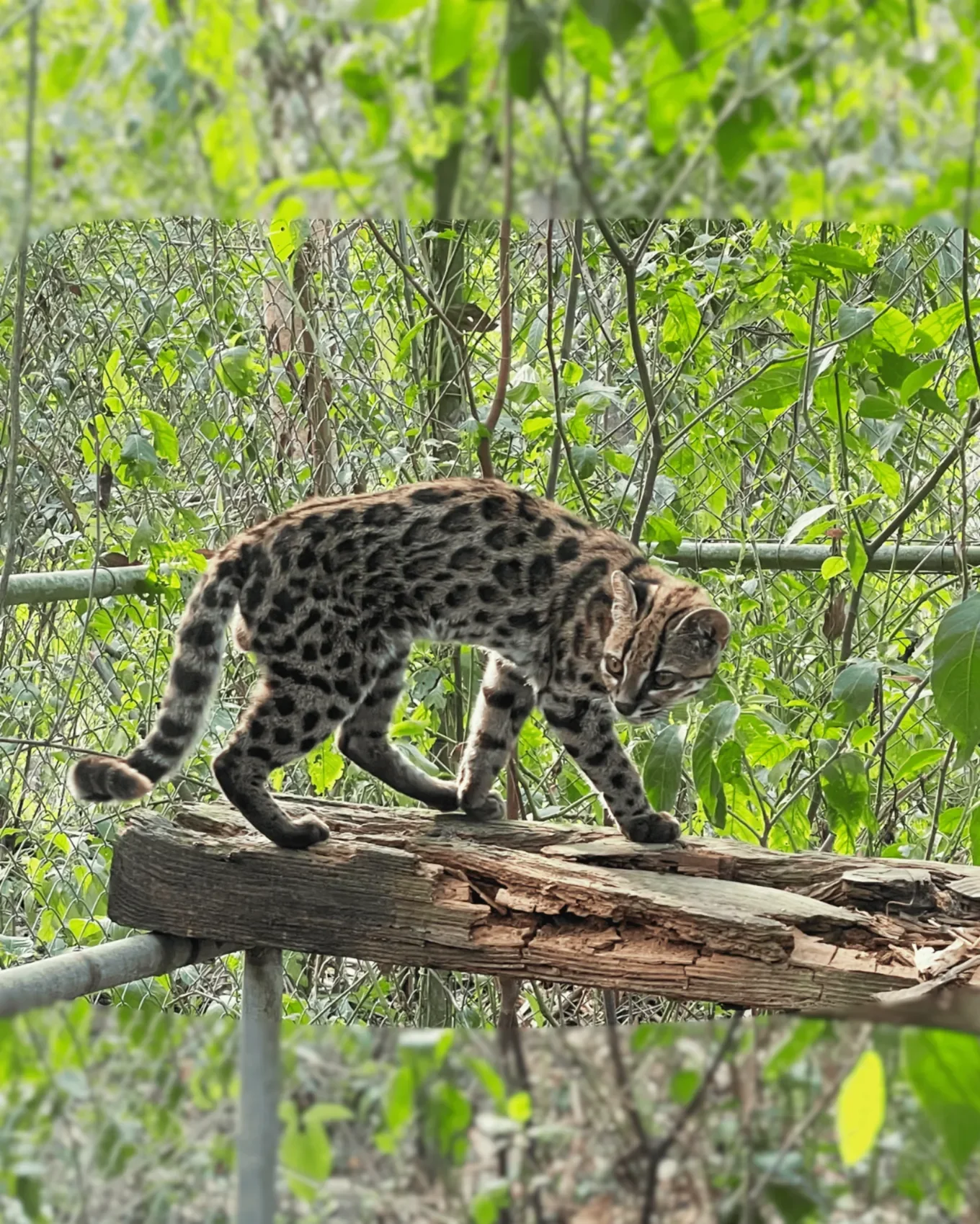
Tiger Cats
Tilcayo (Leopardus tilcayo ) Newsweek
https://www.newsweek.com/new-tiger-cat-species-tilcayo-bolivia-species-risk-extinction-12462051
A man in Bolivia found a kitten on a road near the forest and took it home, thinking it was a house cat. After about a year, its behavior convinced him he was living with a wild animal, and he brought it to the Senda Verde wildlife sanctuary. In 2017, the sanctuary called Bolivian biologist Paola Nogales-Ascarrunz to come have a look. She recognized the little spotted animal as a tiger cat and assumed it was a northern tiger cat. Two years later, while preparing a guide to Bolivia’s cats, she compared her photographs with a reference photo from Brazil. The Bolivian cat had much larger rosettes.
That observation helped lead to a discovery. In 2026, Nogales-Ascarrunz and her colleagues published a study comparing whole genomes from living cats and museum specimens. They identified five distinct species of South American tiger cat, including one previously undescribed by science. For its scientific name, Leopardus tilcayo, the researchers drew on a name families in Bolivia’s Yungas had used for generations.
Four of the five species occur around the margins of Amazonia. To the northwest, the clouded tiger cat (Leopardus pardinoides) inhabits cloud forests in the northern Andes. The northern tiger cat (Leopardus tigrinus) has a surprising distribution. It occurs in the Guiana Shield to the northeast, but its relatives in the Peruvian Yungas belong to the same species. The researchers named the Peruvian population as a subspecies, L. tigrinus antisuyo. Farther south along the eastern slope of the Andes, the tilcayo inhabits the mountain forests of the Bolivian Yungas.
On the Brazilian side of the Amazon, the habitats change. The eastern tiger cat (Leopardus emiliae) ranges through the savannas of the Cerrado and the dry scrublands of the Caatinga. The fifth species, the southern tiger cat (Leopardus guttulus), lives farther from Amazonia in the Atlantic Forest.
Why are tiger cats so scarce in the vast lowland rainforest between these populations? One possible explanation is the ocelot effect. Tiger cats are capable climbers, but they spend much of their time on the ground, where they hunt small prey. There they can encounter the much larger ocelot, which can kill smaller cats. Researchers have found that tiger cats tend to be scarce where ocelots are common and can reach higher densities where ocelots are rare. That pattern may help explain the gap in central Amazonia, though the five species’ different habitat preferences also matter.
Recognizing five species changes how we judge their risk of extinction. In 2016, the International Union for Conservation of Nature listed the northern tiger cat as Vulnerable under the broader definition of the species used at the time. Each of the five now needs to be considered across its own range. For the tilcayo, even the most basic conservation question remains open. People in the Yungas have known this cat for generations, but scientists still don’t know how many live in the wild.
References:
Lescroart, Jonas. Nogales-Ascarrunz, Paola. Cassatt-Johnstone, Molly. Alisha-Rossel Enzo. Svardal, Hannes. Eizirik, Eduardo. (October 5, 2026) Phylogenomics and museomics reveal five distinct species of tiger cats in South America Current Biology Volume 36 Issue 19 Pages 5027-5041
https://www.cell.com/current-biology/abstract/S0960-9822(26)01110-3
Payán, E. De Oliveira, T. (2016) Northern Tiger Cat International Union for the Conservation of Nature Red List
https://www.iucnredlist.org/species/54012637/50653881
Northern Tiger Cat Facts Big Cat Rescue
https://bigcatrescue.org/conservation-news/northern-tiger-cat-facts
Bittel, Jason. (September 17, 2026) Meet the First New Cat Species Discovered in 100 Years National Geographic